History of Iran - Part 14
The current situation in the Middle East has focused attention on Iran — a country whose history rivals that of any on earth, stretching back over 5,000 years and encompassing 29 UNESCO World Heritage sites. UNESCO (United Nations Educational, Scientific and Cultural Organization) defines a World Heritage Site as a landmark or area recognized for its outstanding cultural, historical, or natural significance and protected under an international treaty for the benefit of all humanity.
This is part 14 of a multi-part series examining that history.
Click here for a list of the articles in this series.
The Iranian Intermezzo
The Abbasid caliphate relied heavily on Persian administrative traditions and officials to run its sprawling empire — a debt owed to over a thousand years of Persian experience governing large territories, going back through the Sasanians and Achaemenids. The caliphs appointed Persians as amirs (governors) of various regions within the former Sasanian Empire. Over time, the caliph, while still the nominal head of the Islamic world, no longer controlled the affairs of these regions directly. A series of Persian dynasties, led by these amirs, became the effective rulers of Iran for over two hundred years. These hereditary dynasties overlapped with each other, often controlling different parts of Iran simultaneously rather than succeeding one another in a clean sequence. This period, running roughly from 821 to 1055, is called the Iranian Intermezzo, and it led to a revival of Persian language and culture.
In the early Abbasid period, Persian writers developed a literary movement known as the Shu'ubiyyah (from shu'ub, "peoples" or "nations"), which argued for the equality, if not superiority, of Persian civilization compared to their Arab rulers. This intellectual current, created an environment for the revival that followed.
Central Authority Weakens
The Abbasid authority weakened under the Tahirid and Saffarid dynasties.
Tahir ibn Husayn was appointed governor of the eastern Iranian lands in 821. When he named his own son to succeed him, the governorship effectively became hereditary rather than caliph-appointed. The Tahirid dynasty lasted until the Saffarids conquered it in 873.
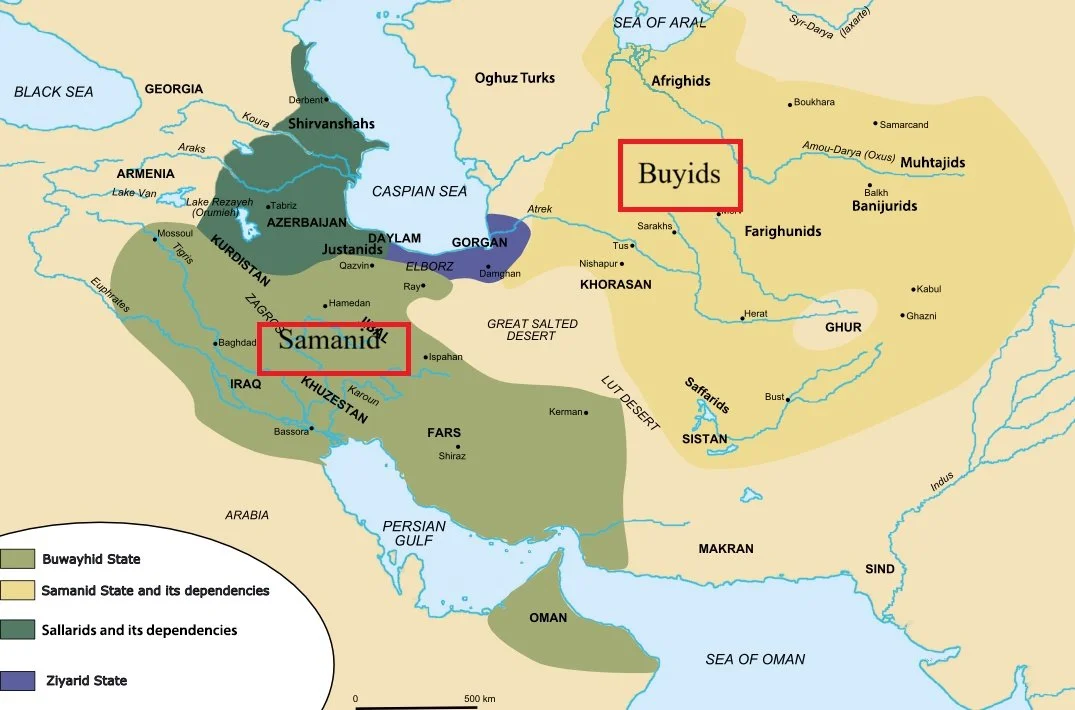
The Samanid and Buyid Dynasties
CC BY-SA 2.5
The Saffarid dynasty was founded by Ya'qub ibn al-Layth in 861. Ya'qub had been a coppersmith (saffar in Arabic and Persian) before joining the ayyarun, meaning ‘vagabond’ and referring to groups of irregular soldiers. He built a following through military success and conquered the territory the Tahirids had governed. By taking authority through force, Ya'qub represented a break from caliphal legitimacy. At one point, he marched his army toward Baghdad itself.
Ya'qub provided an early spark of Persian cultural revival. After a military victory, he asked why a courtier was addressing him in Arabic, a language he didn't understand — and had his secretary compose verses in Persian instead. In 867, he sent the Abbasid caliph a poem invoking Derafsh Kaviani, the national flag of pre-Islamic Iran: “With me is the Derafsh Kaviani, through which I hope to rule the nations.” He was framing his revolt as a revival of Persian glory. Today the flag is a symbol of resistance against the Islamic Republic of Iran.
The Samanids defeated the Saffarids in 900, leaving them with a remnant of their former lands that persisted until 1003.
The Samanids (819 – 999)
The Samanids led a full Persian revival. The dynasty was founded by four brothers, each governing a separate province, before the line consolidated under Ismail Samani, a son of one of the four. Under Samanid rule, Persian became the language of government and literature once again, largely displacing Arabic. There was a famous edict attributed to the Samanids, “here, in this region, the language is Persian, and the kings of this realm are Persian kings.” The intellectual case made by the Shu'ubiyyah movement came to fruition.
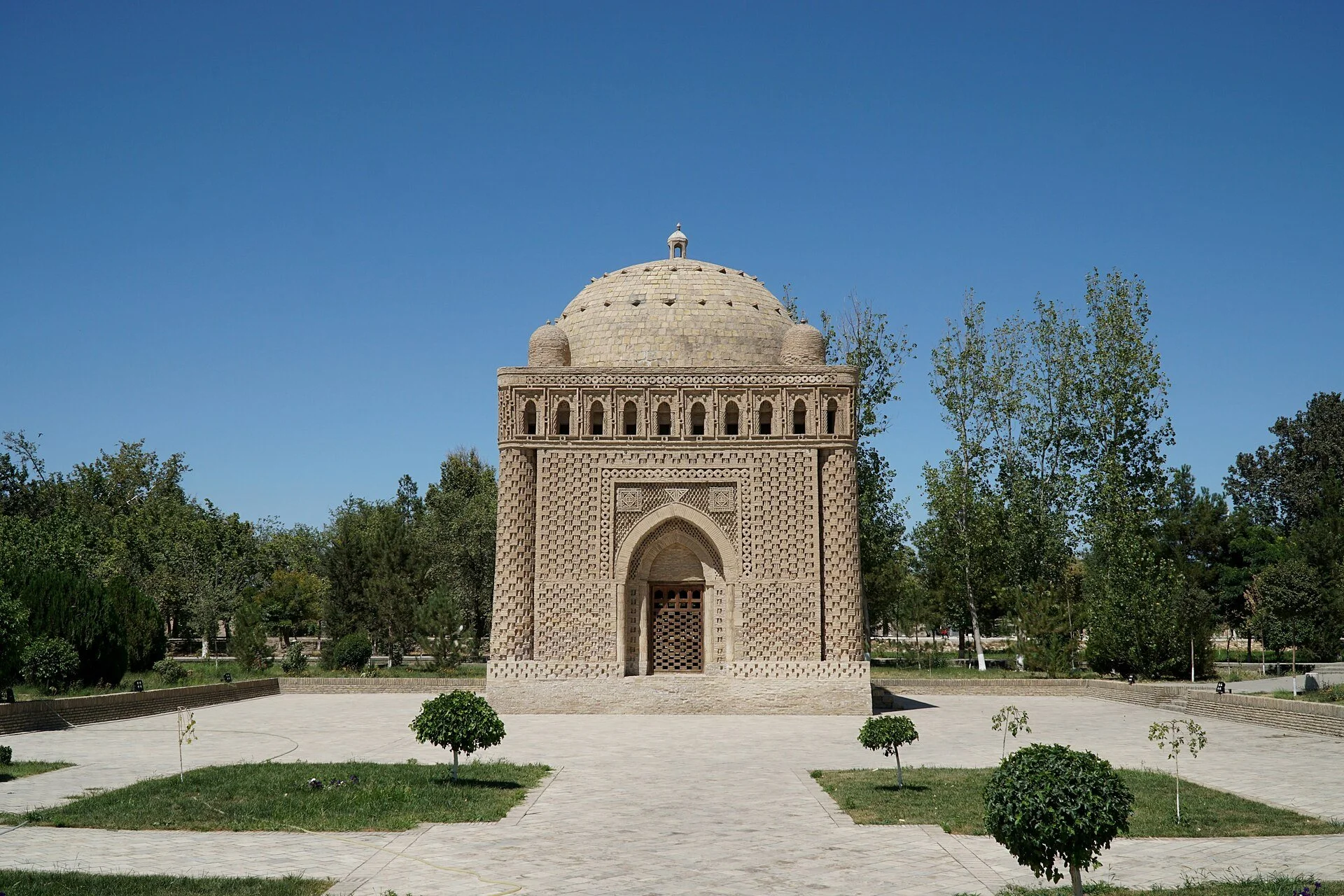
Ismail Samani Mausoleum - Founder of the Samanid Dynasty - located in Uzbekistan
The poet Rudaki, often called the father of Persian poetry, was patronized by the Samanid court for decades. He is believed to have composed as many as 180,000 couplets in his lifetime; only around 1,000 survive today. Modern-day Tajikistan was part of the Samanid realm during this era, and the country still celebrates an annual Rudaki Day every September 22, with streets, parks, and even currency bearing his name.
Ferdowsi began his work on the Epic Shahnameh (King of Kings) under the Samanids. This work is central to Persian identity and is almost twice the length of Homer’s Iliad and Odyssey, a will be the subject of a separate essay in this series.
These developments unfolded during the Islamic Golden Age, a period of scientific, mathematical, and medical advancement across the Islamic world. You could argue that this whole period is when Iran became genuinely Islamized, but never Arabicized: the religion took root permanently, while the language and cultural identity did not.
The Buyids (934 – 1062)
While the Samanids held the eastern Iranian world, the Buyids came to control the western part.
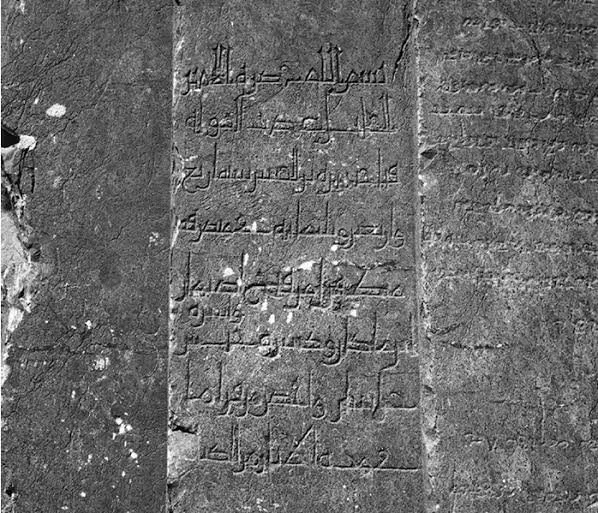
Buyid Inscription at Persepolis - “The amir Aby Shuja’ ‘Adud al-Dawla, may God sustain him, was present in Safar of the year 344 [June 955] and the writing of these ruins was read to him.”
By medieval-islamic-history.com - https://medieval-islamic-history.com/adud-al-dawla/, CC0
The Buyid dynasty was founded by three brothers — Ali, Hasan, and Ahmad ibn Buya — sons of a fisherman from the Caspian region. They each took different territorial regions, and the youngest, Ahmad, seized Baghdad itself in 945. He received the title Mu'izz al-Dawla ("Fortifier of the Dynasty") .
al-Mustakfi was the reigning Abbasid caliph and had no choice but to recognize Buyid authority. Despite this, the Buyids deposed and blinded al-Mustakfi. He died after several years in prison. Some of the Buyid rulers used the ancient Sasanian title of Shahanshah, literally “king of kings.” They added inscriptions to the ancient capital of Persepolis, furthering their identification with pre-Islamic Iran.
Other Dynasties
The Samanids and Buyids weren't the only regional powers to emerge during the Intermezzo. A number of smaller dynasties — Persian, Kurdish, and otherwise — carved out their own territories from the weakening Abbasid center during these two centuries. Most notable among them were the Ghaznavids. Their founder, Sabuktigin, began as a Turkic slave-soldier in Samanid service before inheriting authority over the city of Ghazna. In 999, his son Mahmud of Ghazni seized the former Samanid heartland outright. Despite their non-Persian origins, the Ghaznavids embraced Persian culture rather than displacing it, ruling for almost 200 years—long enough that, under their patronage, Ferdowsi finally completed the *Shahnameh*.
The Golden Age
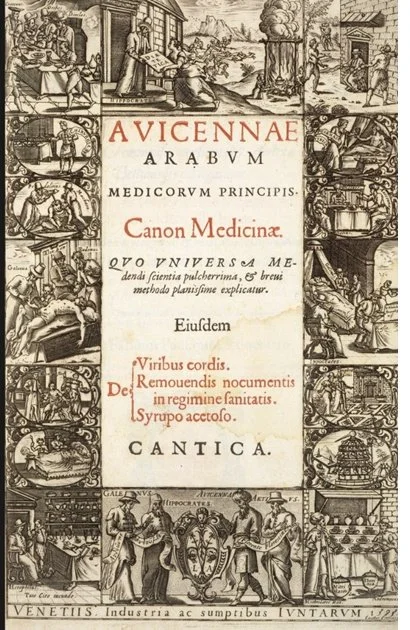
Avicenna Canon of Medicine
The Iranian Intermezzo was part of the Islamic Golden Age, a period of scientific and cultural development. Avicenna, who came of age under the Samanids and later worked under the Buyids, completed several enduring works during this era. The Canon of Medicine, a comprehensive medical encyclopedia, was completed in 1025. It became the standard medical text in the Islamic world and Europe well into the 1600s. He also published The Book of Healing in 1027. This book was a philosophical and scientific encyclopedia intended to ‘cure’ ignorance of the soul.
The broader Islamic Golden Age included Persian mathematician Al-Khwarizmi, considered the creator of algebra. When his works were translated into Latin, his name was transformed into ‘algorithm’, the word used today for a systematic approach to solving a problem.
The End of the Intermezzo
A new power arose from the Central Asian Steppe, the Seljuk Turks, who took Baghdad from the Buyids in 1055, and began the next era in Iranian history – the subject of a future essay. Although the Intermezzo ended almost one thousand years ago, its effects are felt today, in the revival of the Persian language and culture.