History of Iran - Part 15
The current situation in the Middle East has focused attention on Iran — a country whose history rivals that of any on earth, stretching back over 5,000 years and encompassing 29 UNESCO World Heritage sites. UNESCO (United Nations Educational, Scientific and Cultural Organization) defines a World Heritage Site as a landmark or area recognized for its outstanding cultural, historical, or natural significance and protected under an international treaty for the benefit of all humanity.
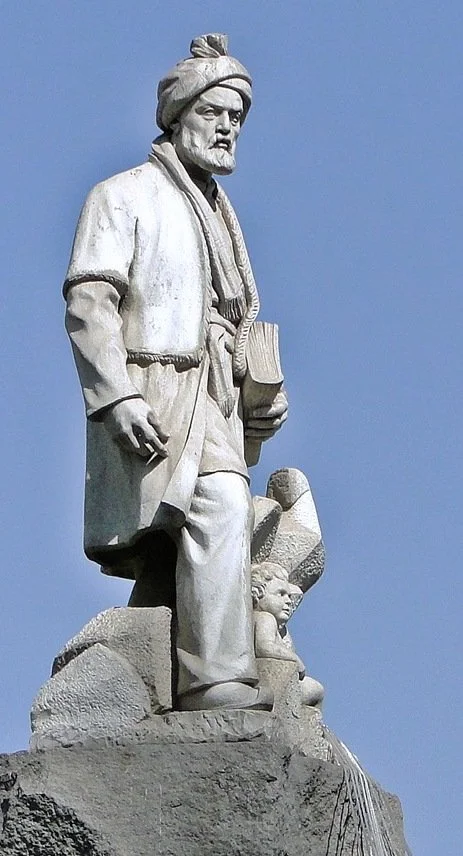
Ferdowsi - Uploaded by Ibolya Horváth - CC BY-NC
This is part 15 of a multi-part series examining that history.
Click here for a list of the articles in this series.
The Shahnameh: Iran's Book of Kings
As covered in Part 14, one of the Iranian Intermezzo's most consequential legacies was literary. Around 977 CE, a poet named Ferdowsi, working under Samanid patronage in the city of Tus, began composing an epic poem intended to preserve Iran's entire pre-Islamic identity, memory, and language from Arabic dominance. He would spend roughly the next 30 years on it, finishing around 1010 — by which point his original Samanid patrons had fallen, and the finished work was instead dedicated to the Turkic Ghaznavid sultan Mahmud of Ghazni.
Ferdowsi was disappointed in his payment for three decades of work, according to Nizami-i-Arudi, a 12th-century biographer who visited the poet's tomb less than a century after his death. He received only a fraction of what he was promised. Insulted, he reportedly went to the public baths, and on his way out gave away the entire sum between the bath attendant and a street vendor selling a cheap beer, in a public gesture of contempt for the payment. Legend holds Mahmud finally sent a caravan of goods as a belated apology on the very day Ferdowsi's funeral procession left the city by another gate.
The result, the Shahnameh ("Book of Kings"), runs to roughly 50,000 couplets — around 100,000 lines, nearly twice the combined length of Homer's Iliad and Odyssey. Unlike Homer's epics, which may have emerged from oral tradition, with some scholars questioning authorship, the Shahnameh is the work of a single identifiable poet. And crucially, Ferdowsi wrote it deliberately in Persian (Farsi), using as few Arabic words as possible. This was a conscious act of linguistic preservation as much as storytelling. It's often credited as the single most important reason Persian survived and flourished as a major world language.
The Structure: Three Ages
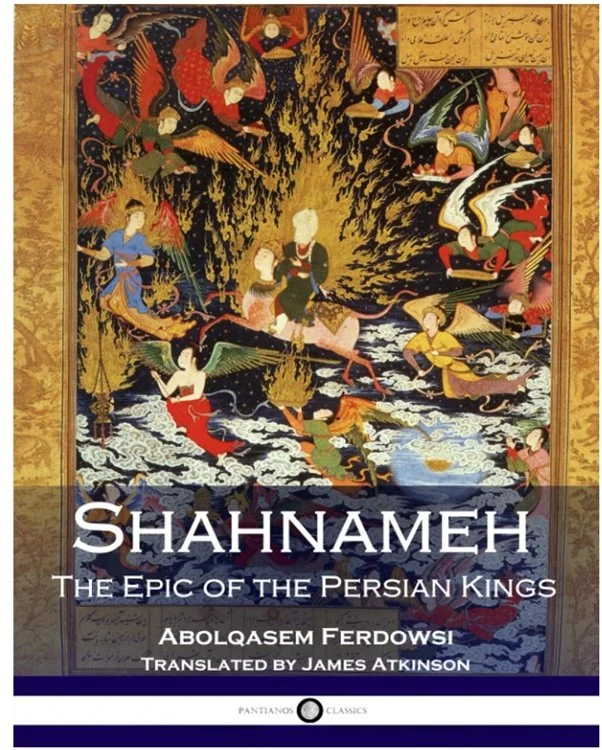
One of many editions of the Shahnameh
The poem organizes Iranian history into three ages, moving gradually from pure myth toward something resembling real history:
The Mythical Age (the shortest section) covers creation, the first kings, and the foundational struggle between good and evil.
The Heroic Age (by far the largest section) covers the long wars between Iran and its rival Turan, with the warrior Rostam as its central figure across multiple generations of kings.
The Historical Age covers Alexander the Great's conquest and the Parthian and Sasanian dynasties, ending with the Arab conquest in 651.
Here are some sample stories:
Kaveh and Zahhak — The Mythical Age
Zahhak was an evil king installed by Ahriman, an evil spirit. Two serpents grew on his shoulders that demanded a daily feast of human brains. Kaveh, a blacksmith, has already lost seventeen sons to the serpents' hunger. Kaveh refuses to lose his child. He tears apart a royal decree meant to legitimize Zahhak’s rule. He sparks a rebellion using his leather apron as a banner.
"Be this our banner to march forth and seek out Feridoun and entreat him that he deliver us from out the hands of the Serpent-King."
The rightful heir Fereydun answers the call, overthrows Zahhak, and has the apron encased in jewels and rich brocade — creating the Derafsh Kaviani, the flag of pre-Islamic Iran. This was the banner captured by Arab forces when they toppled the Sasanian Empire more than a thousand years later, and the same banner Ya'qub ibn al-Layth invoked in his own revolt against the caliphate as part of the Iranian Intermezzo.
Rostam and Sohrab — The Heroic Age
Rostam is an Iranian legendary hero. He was born to the powerful warrior Zal and the beautiful princess Rudaba. Rostam serves generation after generation of kings, saving Iran from ruin, and survives a gauntlet of monsters and trials known as his Seven Labors. And yet he encounters tragedy in the story of Sohrab.
Rostam fathered a child during a brief encounter with a foreign princess and never learns it was a boy named Sohrab. Sohrab grows up in the rival land of Turan and sets out, hoping to find his father. They end up meeting as enemies on the battlefield, but neither knows the other. After two days of combat, Rostam mortally wounds Sohrab and discovers an armband he had given Sohrab's mother years before:
"I that am old have killed my son. I that am strong have uprooted this mighty boy. I have torn the heart of my child, I have laid low the head of a Pehliva."
It's often compared to Greek tragedy for its dramatic irony — the reader knows the truth the entire time; only the characters don't. The story is directly referenced in Khaled Hosseini’s best-seller, The Kite Runner.
Siyavash — The Heroic Age
Prince Siyavash, falsely accused of impropriety by his stepmother Sudabeh, proves his innocence by riding through a massive wall of fire unharmed — sacred fire, in Zoroastrian belief, being incapable of harming the innocent. Later, ordered by his own father to break a sworn truce and betray hostages, Siyavash refuses and chooses exile in the rival land of Turan. He's been welcomed there for years, but the king’s brother turns the king against him. Sensing his own death approaching, Siyavash speaks to his horse before riding out to face it:
"Listen, O my horse, and be brave and prudent; neither attach thyself unto any man until the day that Kai Khosrau, my son, shall arise to avenge me."
Siyavash - Trial by Fire - click to expand
He is murdered shortly after. From his spilled blood, legend holds, a plant sprang up, a maidenhair fern, so that even in death his innocence took root and would not die. His son, born in secret, later fulfills that promise, eventually killing the man responsible and closing a cycle of vengeance that spans a generation.
Rostam Farrokhzad's Lament — The Historical Age
The Shahnameh's final age moves from myth into real history: the Parthians and the Sasanian kings. Its closing chapters dramatize the battle of Qadisiyyah, where the Sasanian armies, led by general Rostam Farrokhzad — a historical figure, not a legendary one — lost the decisive battle against the Arab forces.
Before the battle, sensing doom in the stars, Rostam writes a letter to his brother:
"...for four hundred years / None of our royal race will rule the world!"
He turns next to his mother, knowing he won't return:
"Let mother know my words for of a truth / She will not look upon my face again."
And in the letter's most devastating line, he names the battlefield as his own grave before he's even fought on it:
"Because this Kádisíya is my charnel, / My breastplate is my shroud, my helmet blood: / Such is the secret of the lofty sky."
He goes on to describe an army that can no longer fight the war it's used to:
"My sword, which felled the necks of elephants / And lions at a blow, cannot cut through / An Arab skin!"
Rostam Kills Esfandiyar - click to expand
Iran's national epic, composed some 350 years after the Arab conquest, gives the losing side its own voice, mourning an empire's end in verse.
Echoes of Homer
Scholars have long noticed parallels between the Shahnameh and the Iliad. Encyclopaedia Iranica presents an almost character-by-character comparison. Achilles and Shahnameh hero Esfandiyar have similar stories. Both are invulnerable except for one weakness – Achilles' heel and Esfandiyar’s eyes. Much as Achilles knows that killing Hector will hasten his own death yet does it anyway, Rostam kills Esfandiyar with foreknowledge of the cost, choosing honor and necessity over self-preservation. Whether these echoes reflect distant shared Indo-European mythological roots or simply the universal shape heroic tragedy tends to take, they're a reminder that Ferdowsi's Iran and Homer's Greece, for all their distance, were telling strikingly similar stories about pride, prophecy, and unavoidable fate.
Its Relevance Today
This past July, Christopher Nolan's The Odyssey, a $250 million production, had one of the biggest opening weekends of Nolan's career. It's the latest proof that Homer's epics remain very much alive in popular culture, three thousand years after they were composed.
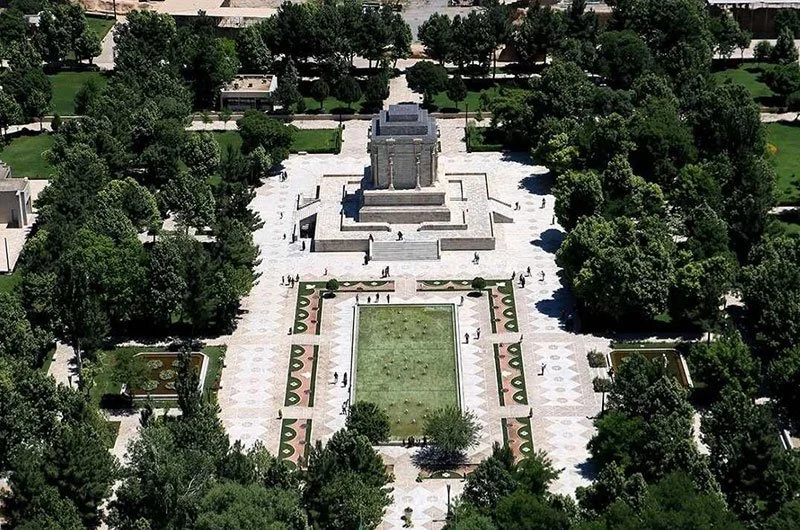
Ferdowsi's Tomb
The Shahnameh hasn't had a Hollywood blockbuster moment quite like that, but remains influential in its own way. Naqqali, the traditional Iranian art of dramatic solo storytelling built around reciting the Shahnameh's tales, was recognized by UNESCO as part of the Intangible Cultural Heritage of Humanity in 2011. Ferdowsi’s mausoleum in Tus remains a major pilgrimage and tourist site. And names straight out of the epic — Rostam, Sohrab, Kaveh, Bahram — remain common given names in Iran today.
The ancient Achaemenid and Sasanian royal necropolis near Persepolis is named after the legendary hero Rostam — Naqsh-e Rostam, "Picture of Rostam" — although Rostam is not part of the site as it predates him by over a thousand years.
The Shahnameh may never get its own IMAX production, but it's been playing continuously, in one form or another, for a thousand years.