History of Iran - Part 11
The current situation in the Middle East has focused attention on Iran — a country whose history rivals that of any on Earth, stretching back over 5,000 years and encompassing 29 UNESCO World Heritage sites. UNESCO (United Nations Educational, Scientific and Cultural Organization) defines a World Heritage Site as a landmark area recognized for its outstanding cultural, historical, or natural significance and protected under an international treaty for the benefit of all humanity.
This is part 11 of a multi-part series examining that history.
Click here for a list of the articles in this series.
The Rise of Islam
While the Sasanian and Byzantine empires were busy exhausting each other in a war that devastated both, a new religion emerged in the Arabian Peninsula: Islam.
Muhammad, who was born in Mecca in 570, received his first divine revelation in 610. One of the verses of the Quran (30:1–4), dated to 615, references the Byzantine-Sasanian war, shortly after the Sasanian conquest of Jerusalem. The verses acknowledge the Byzantine defeat, but accurately prophesied the ultimate triumph of the Romans (referring to the Byzantines) over the Persians.
In 630, after a series of battles, Mecca fell to Muhammad and his followers.
After Muhammad’s death in 632, Islam was led by Caliphs, a person considered to be Muhammad’s successor. The first four Caliphs are known as the Rashidun Caliphate, who led from 632 to 661. This Caliphate conquered the Sasanian Empire. The first caliph, Abu Bakr, reigned from 632 to 634. During this short period, he unified the Arabian Peninsula in a series of battles known as the Ridda Wars. He then launched an invasion of modern-day Iraq, then part of the Sasanian Empire. The Arabs won a series of battles, but suffered a major reverse at the 634 Battle of the Bridge, showing that the Sasanian Empire was still formidable.
The Conquests
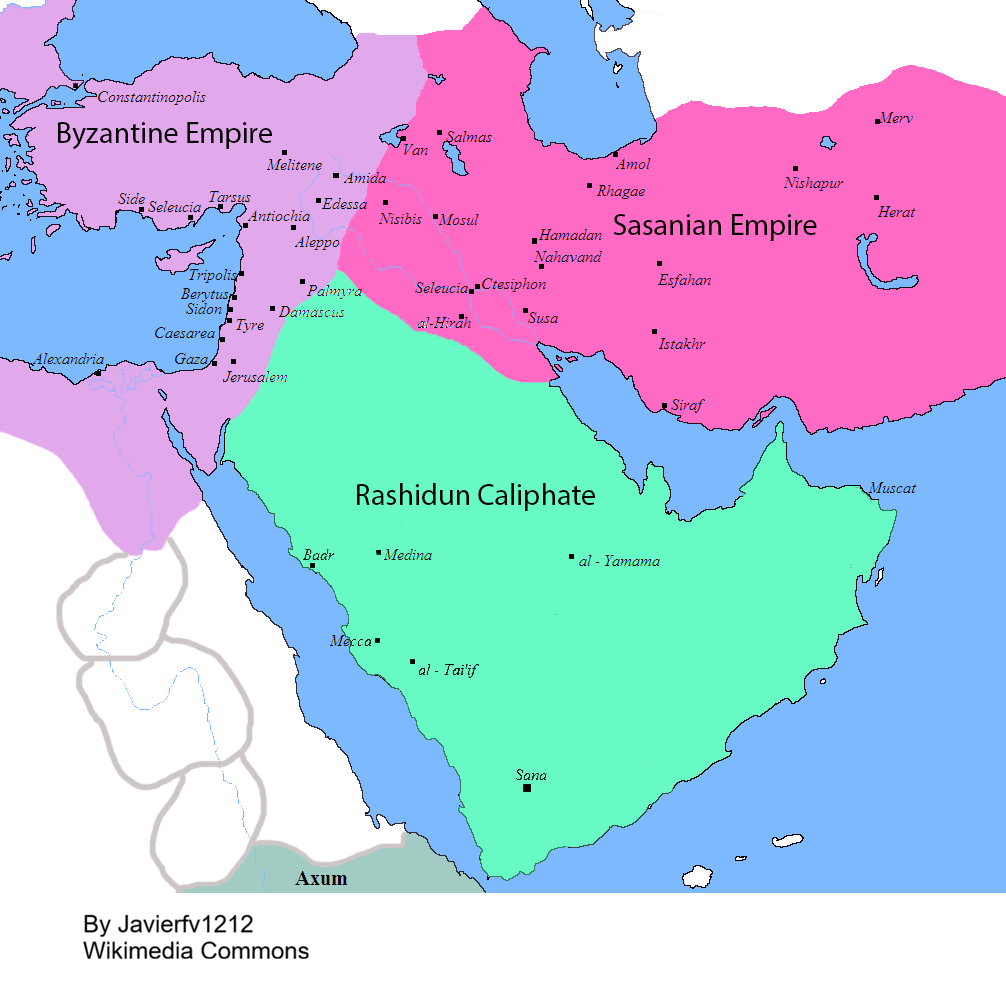
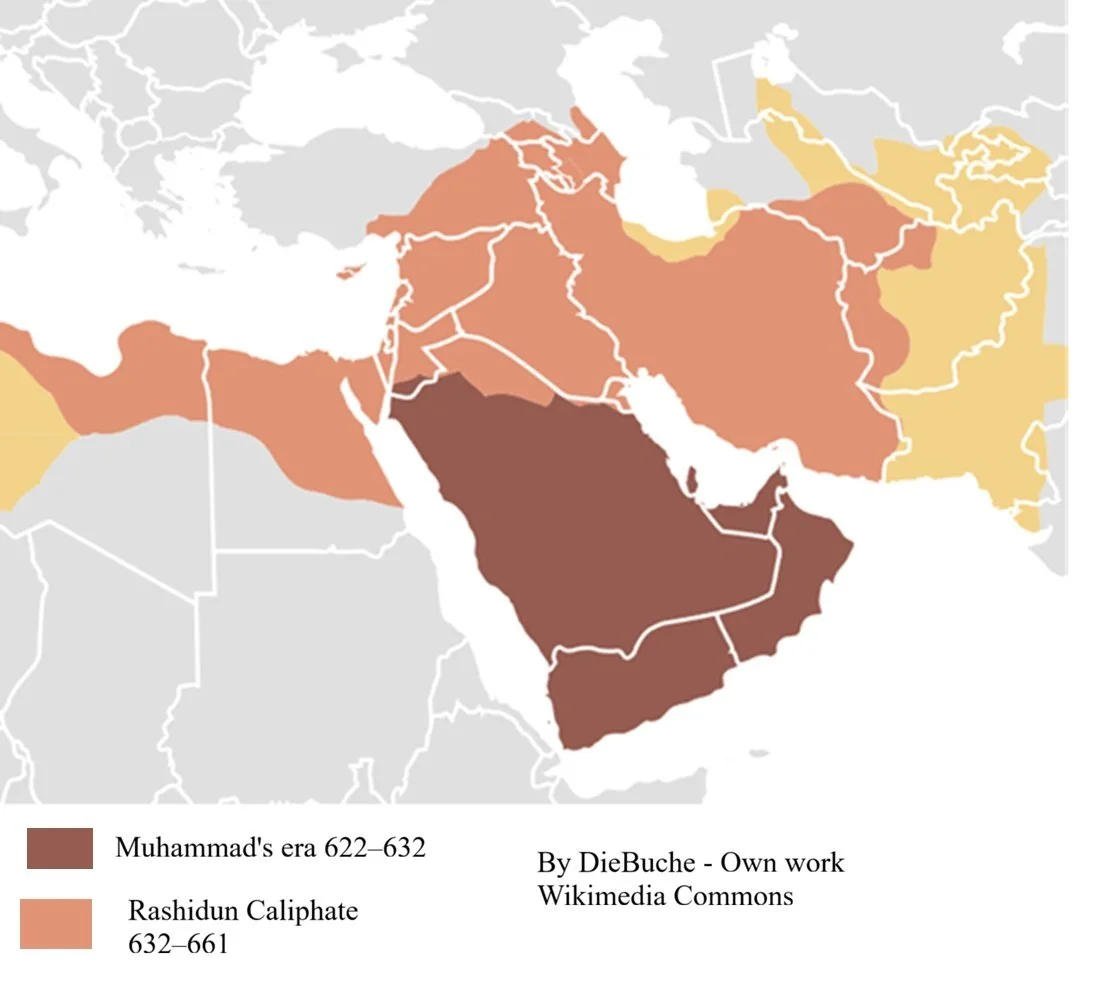
The next caliph, Umar, launched a full invasion of Sasanian Persia in 636. He also attacked Byzantine territory, including Palestine and Egypt. Former mortal enemies, Persia and the Byzantine Empire, formed an alliance against the Arab invaders. Heraclius, victorious commander against the Persians just a few years earlier, was emperor of the Byzantine Empire, while the Sasanians were led by the young Yazdegerd III. The original plan was for both forces to attack simultaneously. Before Yazdegerd could complete the mobilization of his army, the Byzantine forces were engaged by the Muslim invaders at the Battle of Yarmuk in southern Syria. At one point, the Arab forces suffered reversals and started to flee. According to some reports, the retreating soldiers were met by wives and women at their camp. The women gathered tent poles and other weapons and charged at their husbands, shouting their disgust at the retreat. The men turned and returned to the battle. By the end of the battle, the Arabs had decimated the Byzantine army, which was forced to retreat from Syria back into modern-day Turkey.
(The nearby maps show the boundaries before the invasion, and the growth of Islam under the Rashidun Caliphate)
Derafsh Kaviani - By Kourosh kavian 85 - Own work, CC BY-SA 4.0, (Click to Expand)
The Arabs then sent some of their victorious soldiers as reinforcements to face the Sasanians. The Sasanian army was commanded by the general Rostam Farrokhzad and reportedly reinforced with war elephants. Arab forces under Sa'd ibn Abi Waqqas met them at the Battle of al-Qadisiyyah, near the Euphrates River, about ninety miles south of Baghdad. On the fourth day of the battle, the Arabs decisively defeated the Persians, ending a thousand-year-old empire in a few days.
The Arab army captured the Derafsh Kaviani, the national flag of pre-Islamic Iran, during the Battle of al-Qadisiyyah. The jewel-bedecked flag was destroyed following its capture. It remains a symbol of Persian identity to this day.
The Aftermath
Following the victory at al-Qadisiyyah, the Muslims took the Sasanian capital of Ctesiphon in 637. Today, only ruins remain of the former capital.
Yazdegerd III fled east and raised one final army. That army was decisively defeated in 642 in a multi-day battle at the Iranian city of Nahavand. The Caliphate named this the ‘Victory of Victories.’ Yazdegerd was unsuccessful in recruiting any further armies to fight against the Arabs. He was murdered in 651, marking the end of the Sasanian empire.
In the next essay in this series, we will cover the intermingling of the ancient Persian Zoroastrian religion with Islam.