History of Iran - Part 9
The current situation in the Middle East has focused attention on Iran — a country whose history rivals that of any on earth, stretching back over 5,000 years and encompassing 29 UNESCO World Heritage sites. UNESCO (United Nations Educational, Scientific and Cultural Organization) defines a World Heritage Site as a landmark or area recognized for its outstanding cultural, historical, or natural significance and protected under an international treaty for the benefit of all humanity.
This is part 9 of a multi-part series that will examine that history.
Click here for a list of the articles in this series.
The Sasanian Dynasty Culture and the Arts
The dynasty ended almost 1,400 years ago, but its art, architecture, and scholarship are still visible today.
Architecture
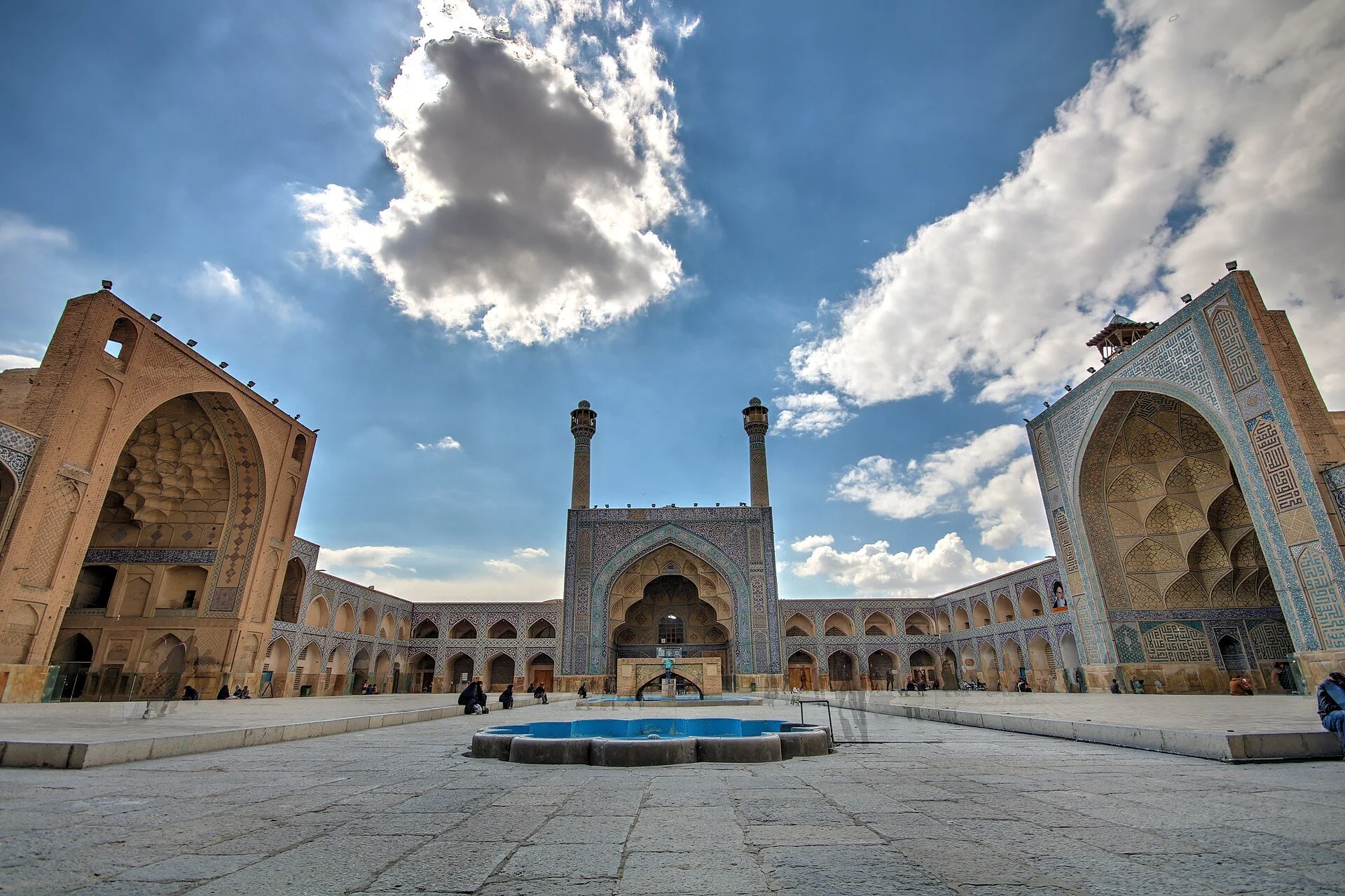
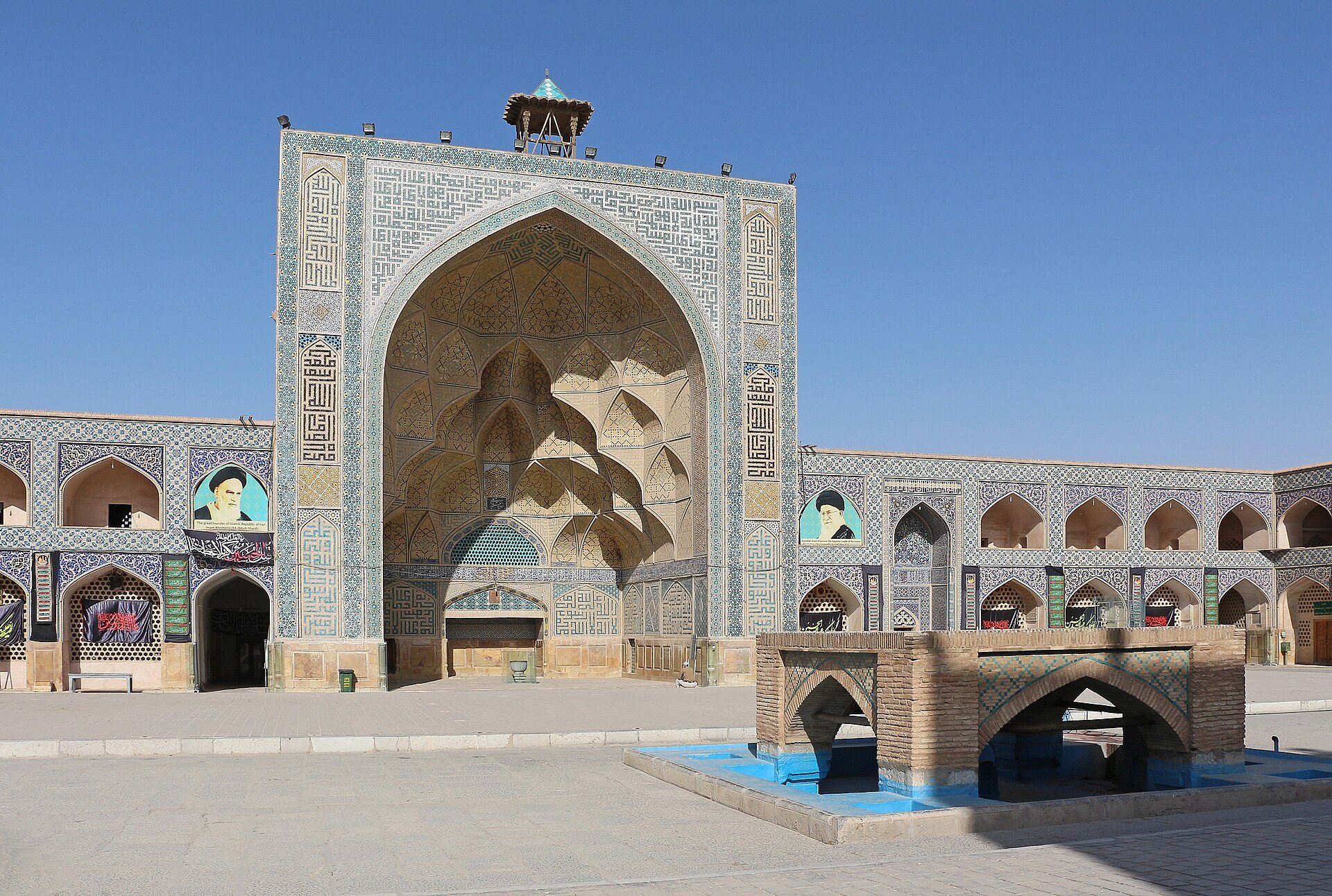
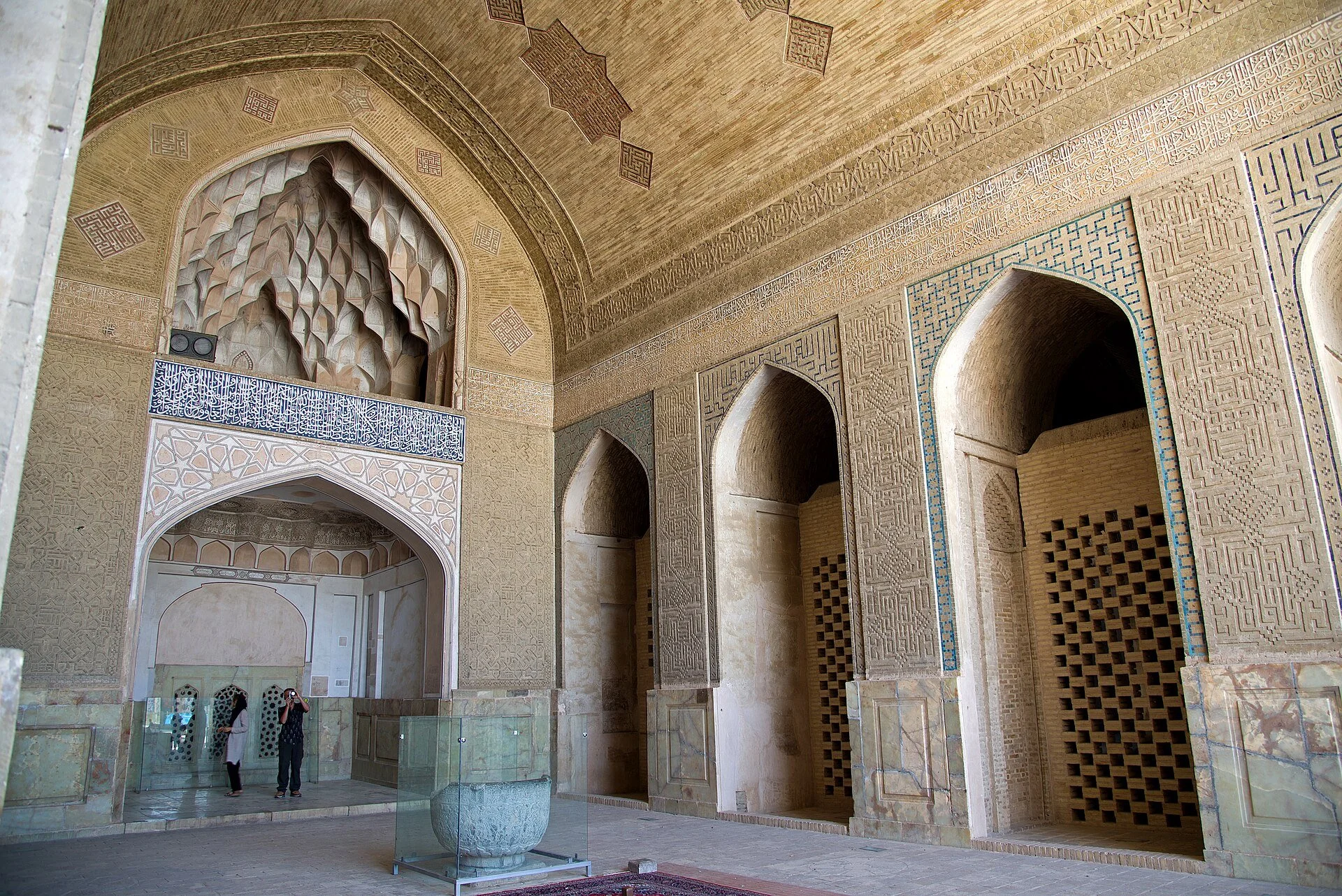
The Sasanians developed two architectural innovations. First was the iwan, an open-fronted vaulted hall. They took the initial Parthian development and made it a central feature of their palaces. The nearby set of three images shows the Jameh Mosque of Isfahan, a UNESCO World Heritage Site. The first shows four iwans facing a central courtyard, a layout that became the standard for Persian mosque architecture and can be found across the Middle East and Central Asia to this day. The second image shows the detail iwan of one of the walls, while the third shows the interior. You can click on each image for an expanded view.
Taq Kasra, click to expand
By Safa.daneshvar - Own work, CC BY-SA 4.0
Second was the dome. The Sasanians developed a technique for placing a circular dome on a square room, using a device called a squinch, an arch built across each corner of the square to create an octagonal base for the dome. This solution spread into Islamic mosques and is visible to this day.
The most dramatic surviving example of Sasanian architecture is the Taq Kasra at Ctesiphon, the Sasanian capital on the Tigris River near modern Baghdad. Its great arch is the largest single-span brick arch ever constructed in the ancient world, soaring approximately 35 meters high. Part of it is still standing today, one of the few physical remnants of a city that was, for centuries, one of the largest in the world.
Art
Sasanian art borrowed from ancient Near Eastern and Greco-Roman traditions, and went on to create a uniquely Persian visual identity. The Sasanians created elaborate silver vessels, including bowls, plates, ewers, and vases.
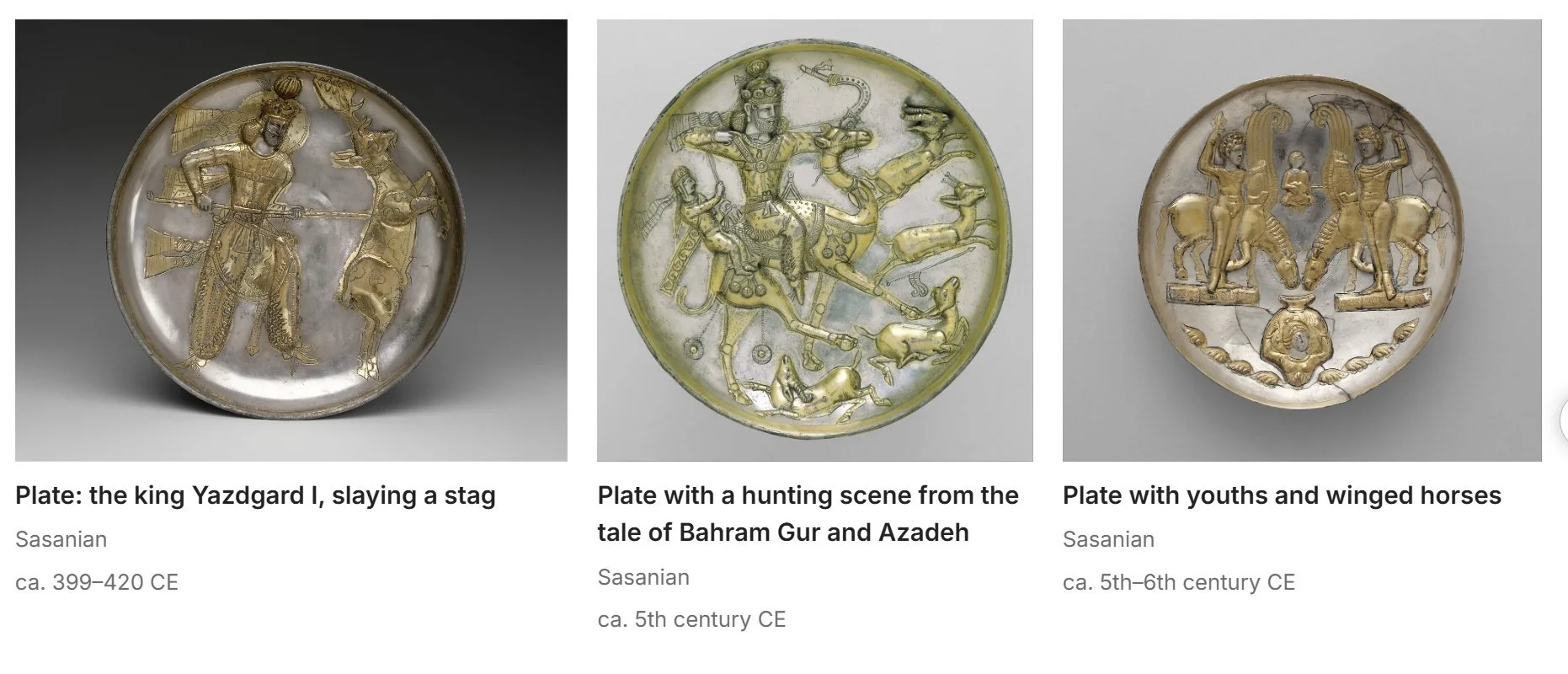
Royal hunting scenes became a popular image of Sasanian silverwork during the reign of Shapur II. Each Sasanian king had a unique crown, allowing scholars to identify rulers on objects that lack inscriptions. A silver plate depicting King Yazdgard I slaying a stag* is a fine example. The king has a unique crown and the commanding posture over the fallen animal conveys the power of the royal court. These plates were often sent as diplomatic gifts to neighboring and vassal courts.
Sasanian artists also adapted Greco-Roman imagery into a Persian context. A plate with youths and winged horses* reimagines the Greek tradition of Pegasus and the divine twins.
The plate with Bahram Gur and Azadeh* depicts a legendary Persian king and his companion on a camel hunt. This was later immortalized in the Shahnameh, the great Persian epic poem.
Beyond silverwork, Sasanian luxury arts included silk textiles, engraved gemstone seals, and glass and ceramic * vessels traded along the Silk Road. One such bowl has been found as far away as Japan. The interiors of Sasanian palaces were decorated with elaborate stucco panels * depicting animals, floral designs, and geometric patterns.
* Links are to the Metropolitan Museum of Art, which has a detailed description of each object. It also has a concise summary of the history and significance of Sasanian art.
Colossal Statue of Shapur, click to expand
By Wiki-in-basel - Own work, CC BY-SA 3.0
As we learned in part 8 of this series, Shapur I was renowned for his military and other achievements. One of the most impressive surviving sculptures of the Sasanian period was this gigantic statue (22 feet high) carved to honor his legacy. The statue collapsed at some point in antiquity and lay on the cave floor for centuries until 1957, when the last Shah of Iran commissioned its restoration. It is open to tourism, reachable via a hike of about 230 steps.
Academy of Gondishapur
Another one of Shapur I’s achievements was the founding of what some historians consider the world's oldest university, the Academy of Gondishapur. One interpretation is that the name in Persian means, ‘acquired by Shapur.’ It became one of the great centers of learning in the ancient world with a hospital, library, and faculties covering medicine, philosophy, mathematics, and astronomy.
Gondishapur combined knowledge from multiple civilizations. Greek texts, including those of Hippocrates and Galen, were translated into Syriac, an offshoot of Aramaic. Indian scholars brought mathematical and astronomical knowledge. Nestorian Christians, followers of a theological tradition declared heretical by the Byzantine church in 431 AD and expelled from the empire, brought their libraries of Greek texts with them when they sought refuge in Persia.
After the Islamic caliphate conquered Persia in the 7th century, Gondishapur was closed and faded into history, but not before its knowledge was transferred to other Islamic institutions. To memorialize Gondishapur, the Shah of Iran founded Jundishapour University in the 1950s. After the 1979 Islamic Revolution, it was renamed Shahid Chamran University in honor of an Iranian revolutionary and military commander.
Music, Poetry and the Shahnameh
The Sasanian court was a center of music. UNESCO has listed the ‘Radif (musical collection) of Iranian music’ as an Intangible Cultural Heritage of Humanity. Click on the nearby video to listen to Ancient Persian Court Music: Sasanian Rhythms & Mystical Melodies.
Even after the fall of the Sasanian Empire, its stories of heroic kings, legendary battles, and Persian glory were passed down to later generations. In around 1000 CE, the Persian poet Ferdowsi drew on these traditions to write the Shahnameh, or Book of Kings, one of the great epic poems of world literature. Covering Persian history from the mythological origins of civilization to the fall of the Sasanians, the Shahnameh played a crucial role in preserving the Persian language and identity through centuries of Arab and later Turkic rule. It is still read and celebrated in Iran today. I even saw a copy in my local bookstore!
The Final War
Alas, the Sasanian empire was coming to an end after over 400 years, as a result of its final war against the Byzantine Empire. We will tell this story in part 10 of this series.