History of Iran - Part 8
The current situation in the Middle East has focused attention on Iran — a country whose history rivals that of any on earth, stretching back over 5,000 years and encompassing 29 UNESCO World Heritage sites. UNESCO (United Nations Educational, Scientific and Cultural Organization) defines a World Heritage Site as a landmark or area recognized for its outstanding cultural, historical, or natural significance and protected under an international treaty for the benefit of all humanity.
This is part 8 of a multi-part series that will examine that history.
Click here for a list of the articles in this series.
The Sasanian Dynasty
Ardashir I receiving the ring of kingship by the Zoroastrian supreme god Ahura Mazda
Click to expand
By Wojciech Kocot - Own work, CC BY-SA 4.0,
In Part 7, we saw how Ardashir, a local ruler from the Achaemenid home province of Persis, overthrew the last Parthian king and established the Sasanian dynasty in 224 CE. The dynasty takes its name from Sassan, an ancestor of Ardashir. Sassan was a Zoroastrian priest or temple guardian in the province of Persis (modern Fars in southern Iran). It was also known as ‘Eranshahr,’ which is Persian for ‘Empire of the Iranians.’ The ancient Indo-Iranian peoples who settled this region called themselves 'Aryans,' a term meaning 'noble' or 'free'. Darius’s tomb has this description: “I am Darius the great king… an Achaemenid, a Persian, son of a Persian, an Aryan, having Aryan lineage.” And Iran essentially means ‘land of the Aryans.’*
Ardashir saw himself as the restorer of the ancient Persian empire of Cyrus and Darius. He made Zoroastrianism the official state religion and had the Avesta, the sacred texts of Zoroastrianism, written down for the first time. While Zoroastrianism now enjoyed state support and a powerful priestly class, the Sasanians generally permitted Jews, Christians, and other faiths to continue practicing, following the tradition of religious diversity that stretched back to Cyrus the Great.
In foreign affairs, one of his first acts was to resume war with Rome. He wanted to retake the former lands of the Achaemenid Empire, now ruled by Rome or independent. He sensed that Rome was weak. The emperor at the time, Alexander Severus, had come to power when he was only 13 years old. Real power resided in his mother, Julia Mamaea. Around 230 CE, Ardashir invaded Roman Mesopotamia, making some territorial gains. Severus personally led a counteroffensive, but the result was inconclusive. Both sides claimed victory, and the border remained largely unchanged. Several years later, the Roman army assassinated Severus and his mother, commencing a long period of Roman instability.
Shapur I and the Defeat of Rome
Naqsh-e Rostam, tombs of Darius the Great, Xerxes, and their successors, click to expand
By Diego Delso, CC BY-SA 4.0,
Ardashir's son Shapur I, who came to power around 240 CE, was one of the most formidable rulers Persia ever produced. He fought several successful campaigns against Rome. The most famous was his defeat of Roman Emperor Valerian in 260 CE at the Battle of Edessa. He had already defeated two Roman emperors before his greatest triumph. Emperor Gordian III was killed during Shapur's first campaign, and Gordian's successor, Philip the Arab, was forced to pay a large tribute to end the war. Shapur captured Valerian, the only time an emperor had been captured in over one thousand years of Roman history. Valerian died in Persian captivity. The exact circumstances are unknown, though Roman sources claimed he was used as a footstool when Shapur mounted his horse, an account that may say more about Roman humiliation than historical fact.
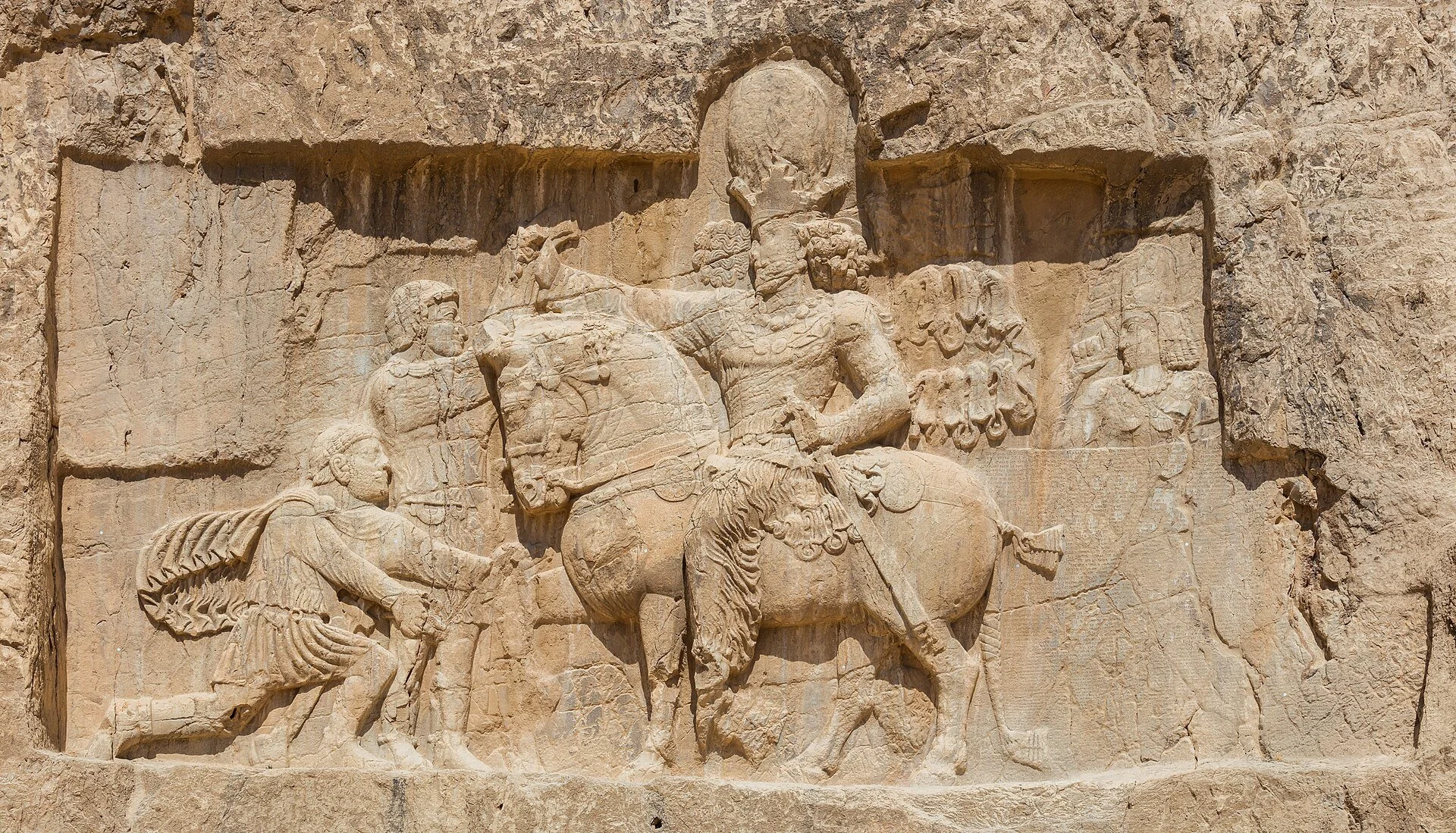
Naqsh-e Rostam, Shapur on horseback, Valerian kneeling, Click to Expand
By Diego Delso, CC BY-SA 4.0,
Shapur had the victory scene carved into the cliffs at Naqsh-e Rostam, one of the most sacred sites in Persian history. Located near Persepolis, the ancient Achaemenid capital, the tombs of Darius the Great, Xerxes, and their successors were carved high into the rock face centuries earlier. The carving shows Shapur on horseback, with Valerian kneeling before him, a dramatic image of triumph. Shapur was also reinforcing the belief that the Sasanian empire was the heir to the great Persian kings of antiquity.
While Shapur was a Zoroastrian, he was tolerant of other religions. Manichaeism***, a new religion founded by the Iranian prophet Mani, flourished during this time. It lasted for over one thousand years before dying out. He maintained good relations with the Jews and is mentioned several times in the Babylonian Talmud, a foundational document of Judaism.
Back and Forth
After Shapur's death in 270 CE, the wars continued, but neither side could deliver a knockout blow. In the Battle of Satala (298 CE), the Romans decisively defeated the Persians, who were forced to cede considerable territory to Rome. But then, in 363 CE, Emperor Julian invaded Persia with a large army, reached Ctesiphon, but was unable to capture it. While retreating, Julian was killed at the Battle of Samarra. The army declared Jovian, the commander of Julian's domestic guard, Emperor. With his army surrounded and low on supplies, Jovian signed a humiliating treaty which included the return to Persia of much of the territory lost in 298 CE, over sixty years earlier.
Byzantine Empire
During this time period, Rome endured a series of succession crises, with dozens of emperors reigning for only months or a few years. Constantine finally brought stability, and in 330 CE, he moved the Roman Empire's capital from Rome to a new city on the Bosphorus, which he named Constantinople (today’s Istanbul).** Over the following century, the empire gradually split into western and eastern halves. The Western Roman Empire collapsed in 476 CE. The Eastern Roman Empire, known as the Byzantine Empire, survived for another thousand years.
Religion became a source of conflict between Persia and Rome. Constantine had converted to Christianity, and by the end of the fourth century, it was the empire's official religion. The Sasanians, whose state religion was Zoroastrianism, now faced a Christian empire on their western border. Shapur II was the king at this time and questioned the loyalty of Christians in his empire. He then put to death an estimated 16,000 Christians. Christians have several feast days to honor what they call the Martyrs of Persia.
Still, with occasional skirmishes, peace reigned between the two empires. Until the year 602 CE, when the final devastating conflict broke out between the Byzantine Empire and the Sasanian Empire. That story will be told in part 9 of this series.
*Yes, sadly, Hitler appropriated this term to describe his ‘master race.’
**The reasons for Constantine's move are long and complex, beyond what can be explained here
*** Manichaeism blended elements of Zoroastrianism, Christianity, and Buddhism into a new faith centered on the cosmic struggle between light and darkness The term manichean is used today to describe a worldview of absolute good versus absolute evil. The map below shows how the religion spread.
By Aldan-2 - CC BY-SA 4.0,