History of Iran - Part 4
The current situation in the Middle East has focused attention on Iran — a country whose history rivals that of any on earth, stretching back over 5,000 years and encompassing 29 UNESCO World Heritage sites.
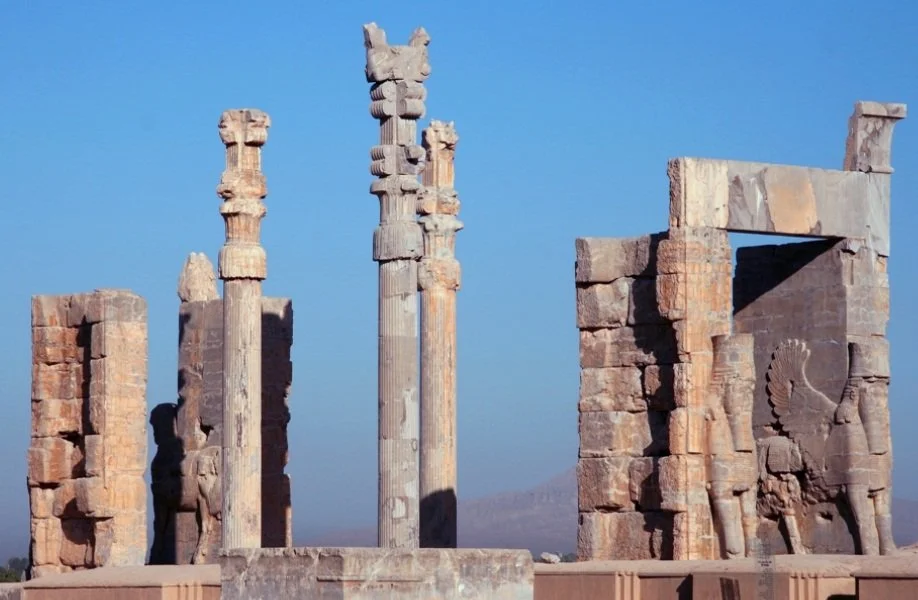
The Gate of All Nations at Persepolis, built by Xerxes.
By Alborzagros - Own work, CC BY-SA 3.0, https://commons.wikimedia.org/w/index.php?curid=15964768
This is part 4 of a multi-part series that will examine that history.
Click here for a list of the articles in this series.
Xerxes
Xerxes inherited the throne from his father Darius in 486 BC. Xerxes was a complex figure. He completed Persepolis, adding the Gate of All Nations, a monumental entrance flanked by massive stone bulls, and the Hall of a Hundred Columns, an enormous throne room. Both survive as some of the most impressive ruins at the site. Xerxes broke the Persian tradition of respecting local religions. For example, during the Babylonian revolt, he melted down the golden statue of Marduk, the chief Babylonian god.

Xerxes is mostly remembered today for his failed invasion of Greece, where he wanted to fulfill his father’s vow to punish Athens for its role in the Ionian Revolt and its victory at Marathon.
Xerxes spent four years preparing a massive invasion force. His empire was the largest in the world at that time. Some sources estimate its population at almost 50 million, over 40% of the world’s population. Greece, by contrast, had a total population of perhaps 2 to 3 million across all its city-states, meaning it was outnumbered by at least fifteen to one.
Greek historian Herodotus gave wildly exaggerated troop figures, but modern historians estimate the invasion force at 100,000-300,000 soldiers. Just feeding them must have been a logistical nightmare. The army was accompanied by over 1,200 warships. To avoid the treacherous waters of Cape Athos, where a Persian fleet had been wrecked during Darius's earlier campaign, Xerxes ordered a mile-wide canal dug across the Athos peninsula in northern Greece. Herodotus described it in detail, and for centuries, scholars dismissed it as exaggeration. Archaeological excavations in the early 2000s confirmed it actually existed.
To cross the Hellespont, Xerxes ordered two pontoon bridges built from boats lashed together. When a storm destroyed them, he ordered the sea given 300 lashes while his men shouted at the water: "You salt and bitter stream, your master lays his punishment upon you for wronging him who never wronged you." He then had chains thrown into the water to symbolically shackle it, and it was branded with hot irons. Whether the storm actually occurred or was invented by Herodotus to set up this scene, it showed Xerxes believed he ruled over nature.
Thermopylae and Artemisium
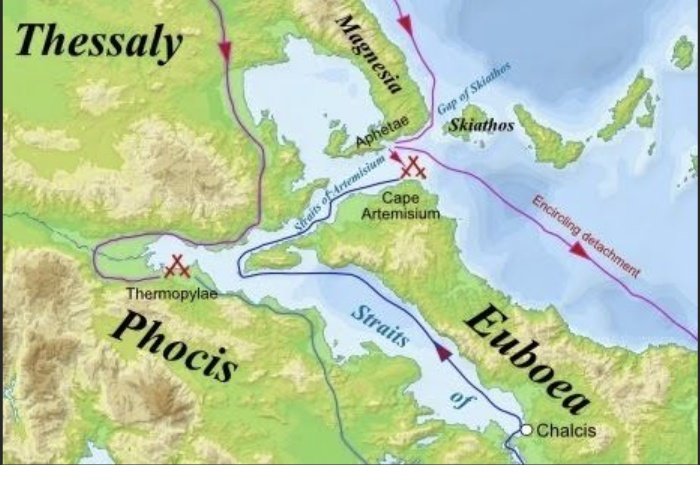
The simultaneous battles of Thermopylae and Artemisium, 480 BC. The Greeks blocked the Persian advance by both land and sea while the Persian fleet attempted to encircle the Greek position
In 480 BC, after building replacement bridges, the Persian army entered Greece from the north. The Greeks chose to make their first stand at Thermopylae, a narrow coastal pass where the mountains meet the sea. This bottleneck neutralized the Persians' numerical advantage. A combined Greek force of around 7,000 men held the pass, led by 300 Spartans under their king, Leonidas. Simultaneously, the Greek fleet engaged the Persian fleet at the nearby Straits of Artemisium, blocking the Persian advance by both land and sea.
For two days, the Greeks held the pass, inflicting heavy casualties on an army that could not bring its superior numbers to bear in the confined space. When a Persian soldier threatened that their arrows would blot out the sun, a Spartan named Dienekes reportedly replied: "Good — then we shall fight in the shade." This battle inspired several movies, including ‘The 300 Spartans’ in 1962 and ‘300’ in 2006.
A Greek traitor named Ephialtes revealed a mountain path that allowed the Persians to outflank the defenders. Leonidas remained with his 300 Spartans and they fought to the last man.
An epitaph was later inscribed at the site, composed by the poet Simonides:
"Go tell the Spartans, stranger passing by, that here, obedient to their laws, we lie."
The sea battle was a tactical draw, but the Greeks withdrew from Artemisium after hearing of the defeat at Thermopylae.
Salamis
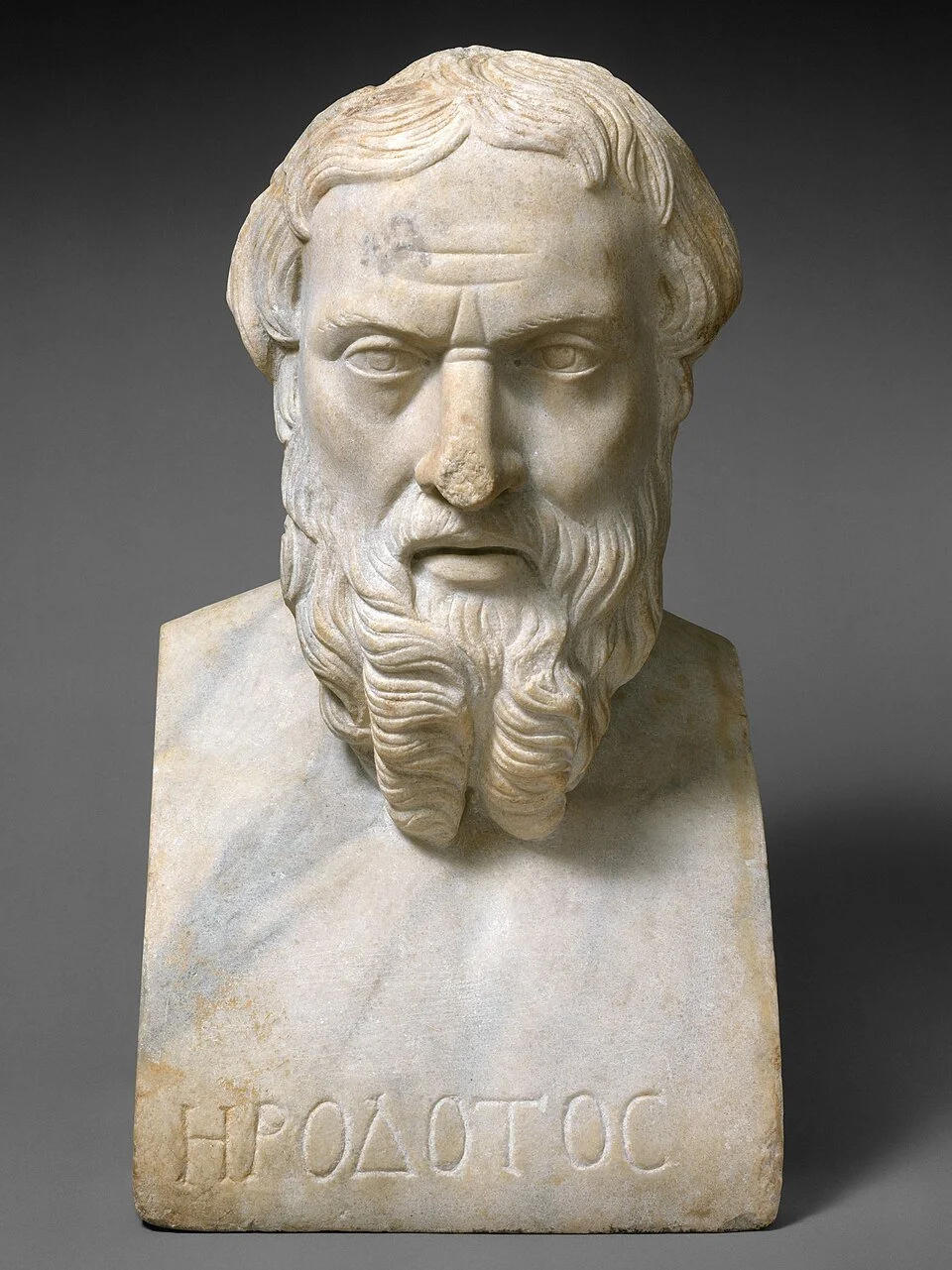
Herodotus - Greek Historian
With Thermopylae lost, the road to Athens lay open. The Athenians evacuated the city by sea before the Persian army arrived and burned it to the ground.
The decisive confrontation came at sea in the narrow strait of Salamis near Athens. According to Herodotus, Greek general Themistocles sent a secret message to Xerxes via a trusted slave, falsely warning him that the Greek fleet was planning to escape under cover of darkness. Xerxes believed it and ordered his fleet into the strait to block the Greek escape. By dawn, the Persians were packed into the narrow waters without any room to maneuver.
The Persian fleet had already lost an estimated 200 ships to storms at Artemisium. Now, in the confined waters of Salamis, the lighter and more maneuverable Greek ships outfought the larger Persian vessels. Xerxes watched the battle from a throne set up on a hillside overlooking the strait and saw his fleet destroyed.
Eight years later, the Athenian playwright Aeschylus, who had fought at Marathon and possibly Salamis himself, wrote The Persians, the oldest surviving play in Western literature. It is set in the Persian capital, where a messenger brings news of the disaster at Salamis to the Persian queen.
The play attributes Persia's defeat to Greek independence and bravery, and to Xerxes's hubris, ending with the return of the broken and humiliated Persian king. The play was popular in the Roman and Byzantine empires, which fought wars against the Persians, and continues to be performed to this day.
A year later, in 479 BC, a final land battle at Plataea in central Greece ended the invasion decisively. Persia never again threatened mainland Greece. The survival of Greece with its philosophy, democracy, and art preserved the foundations of Western civilization, which might otherwise have been absorbed into the Persian empire.
Xerxes and the Book of Esther
The Biblical Book of Esther is set in Susa, the Persian capital, during the reign of King Ahasuerus. Historians generally believe Ahasuerus was Xerxes because the Hebrew name is a transliteration of his name in Old Persian.
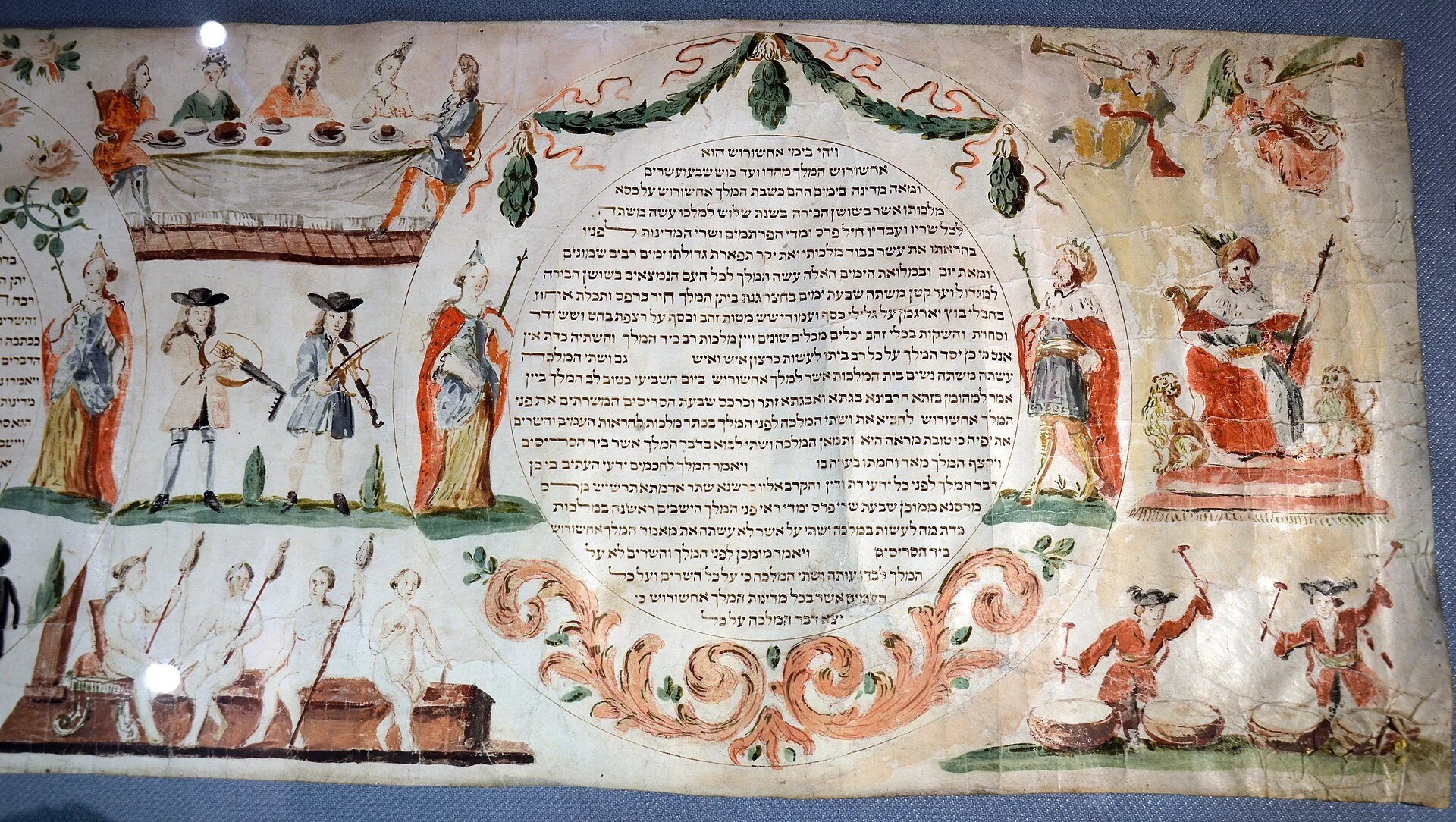
An illustrated Megillah — the traditional scroll of the Book of Esther, read aloud during the Jewish holiday of Purim. This elaborately decorated example is from the Jewish Historical Museum in Amsterdam
By Vassil - Own work, CC0, https://commons.wikimedia.org/w/index.php?curid=31400515
After the king dismisses his queen, Vashti, for refusing a command, he searches the empire for a replacement. A Jewish woman named Esther, raised by her cousin Mordecai, is chosen as the new queen.
Esther conceals her Jewish identity at Mordecai's instruction. Meanwhile, the king's chief minister, Haman, develops a hatred of Mordecai, who refuses to bow to him, and persuades the king to issue a decree ordering the destruction of all Jews in the empire. Mordecai urges Esther to intervene:
"Who knoweth whether thou art come to the kingdom for such a time as this?"
Esther approaches the king, an act punishable by death without royal invitation, and reveals both her identity and Haman's plot. The king reverses the decree, has Haman hanged on the very gallows Haman had built for Mordecai, and allows the Jews to defend themselves. The Jewish holiday of Purim commemorates their survival.
The Death of Xerxes
In 465 BC, Xerxes was assassinated in his bedroom. The exact circumstances and motives remain unclear. His son Artaxerxes took the throne, but not before killing his own brother, a rival claimant. It was an inglorious end for the king who had whipped the sea, burned Athens, and built the magnificent Hall of a Hundred Columns at Persepolis.
Artaxerxes I succeeded him, and that story will be told in Part 5.