History of Iran - Part 3
The current situation in the Middle East has focused attention on Iran — a country whose history rivals that of any on earth, stretching back over 5,000 years and encompassing 29 UNESCO World Heritage sites.
This is part 3 of a multi-part series that will examine that history.
Click here for a list of the articles in this series.
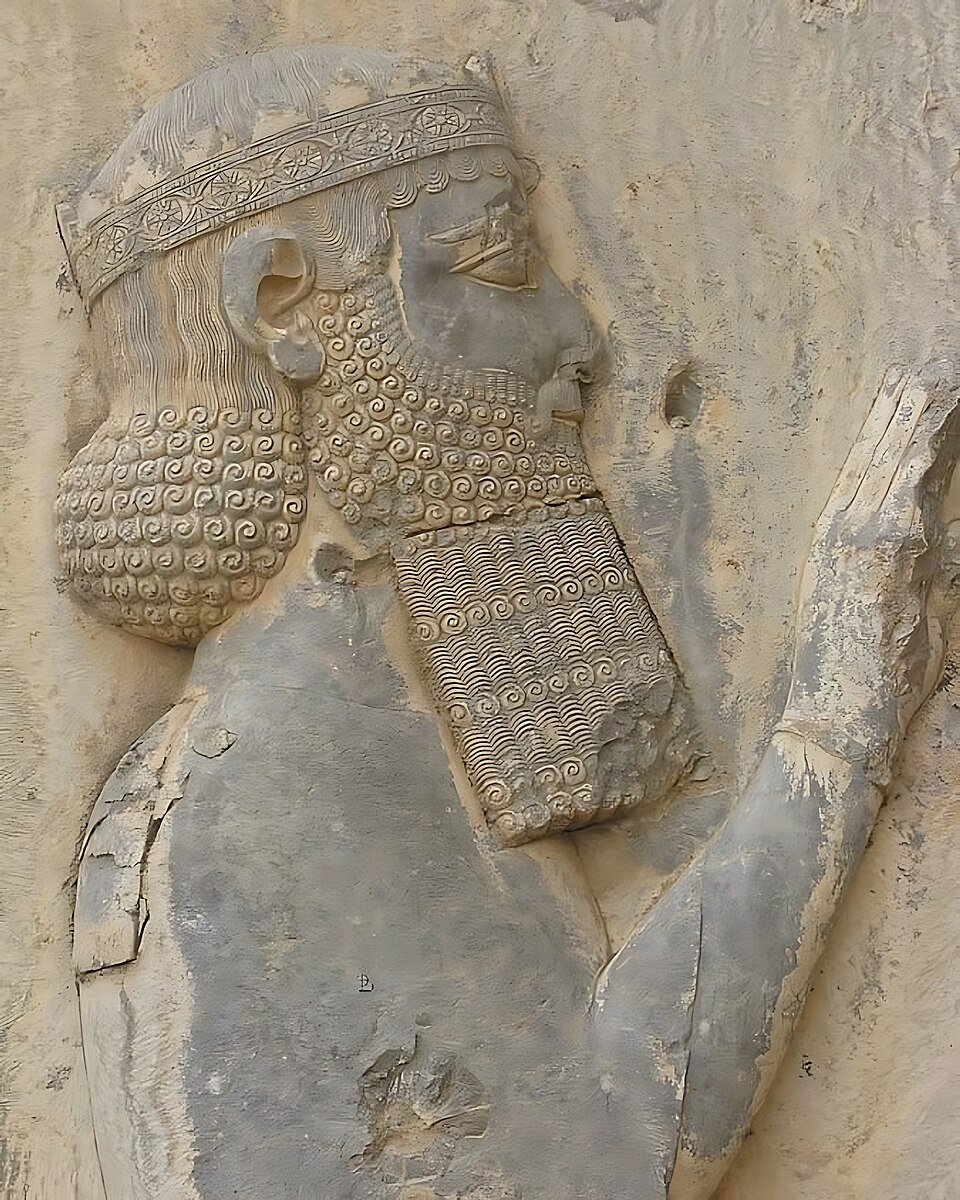
Behistun Inscription: The rock relief of Darius the Great carved 300 feet up the cliff face
Rumlu, Public domain, via Wikimedia Commons
Cambyses
Cyrus was succeeded by his son Cambyses, who ruled from 530 to 522 BC. Cambyses conquered Egypt, defeating the Pharaoh at the Battle of Pelusium in 525 BC and bringing the ancient civilization into the Persian empire. He died in 522 BC under mysterious circumstances while returning to Persia to suppress a rebellion. He left no heir.
Darius the Great
The circumstances of Darius's rise to power are disputed. Greek historians Herodotus and Ctesias provided differing accounts, while Darius himself provided his version of the story. All three versions describe the murder of Cambyses' brother, Bardiya, then someone posing as Bardiya taking the throne after Cambyses’s death. Finally, Darius, a member of the royal family, seized power in a coup.
Darius transformed the empire with a program of construction and engineering:
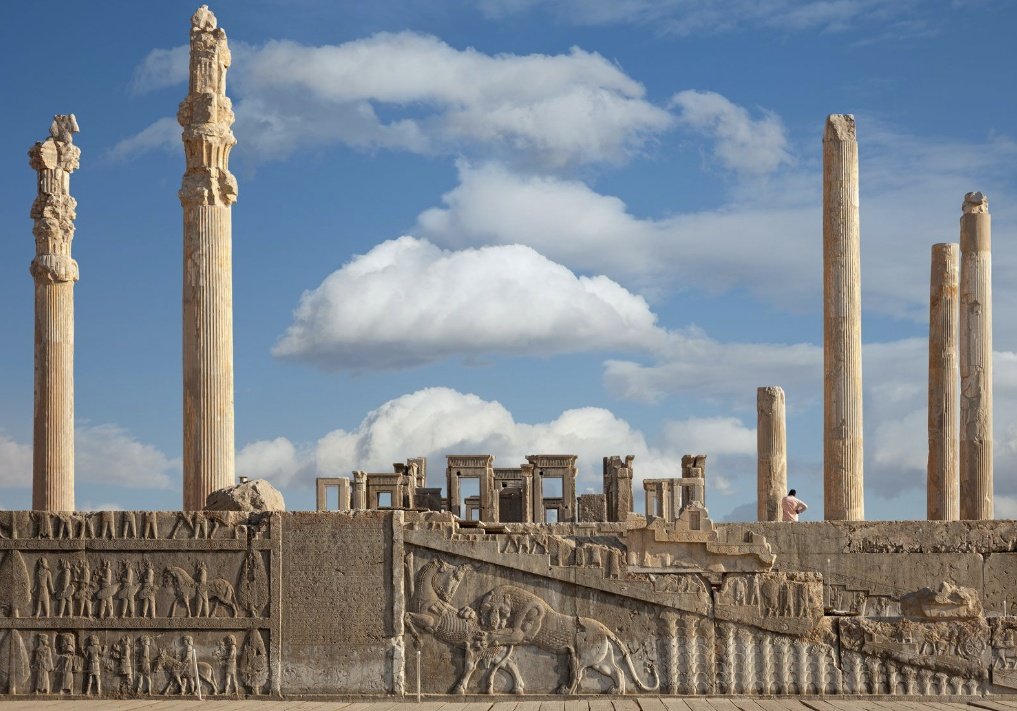
The Apadana staircase at Persepolis
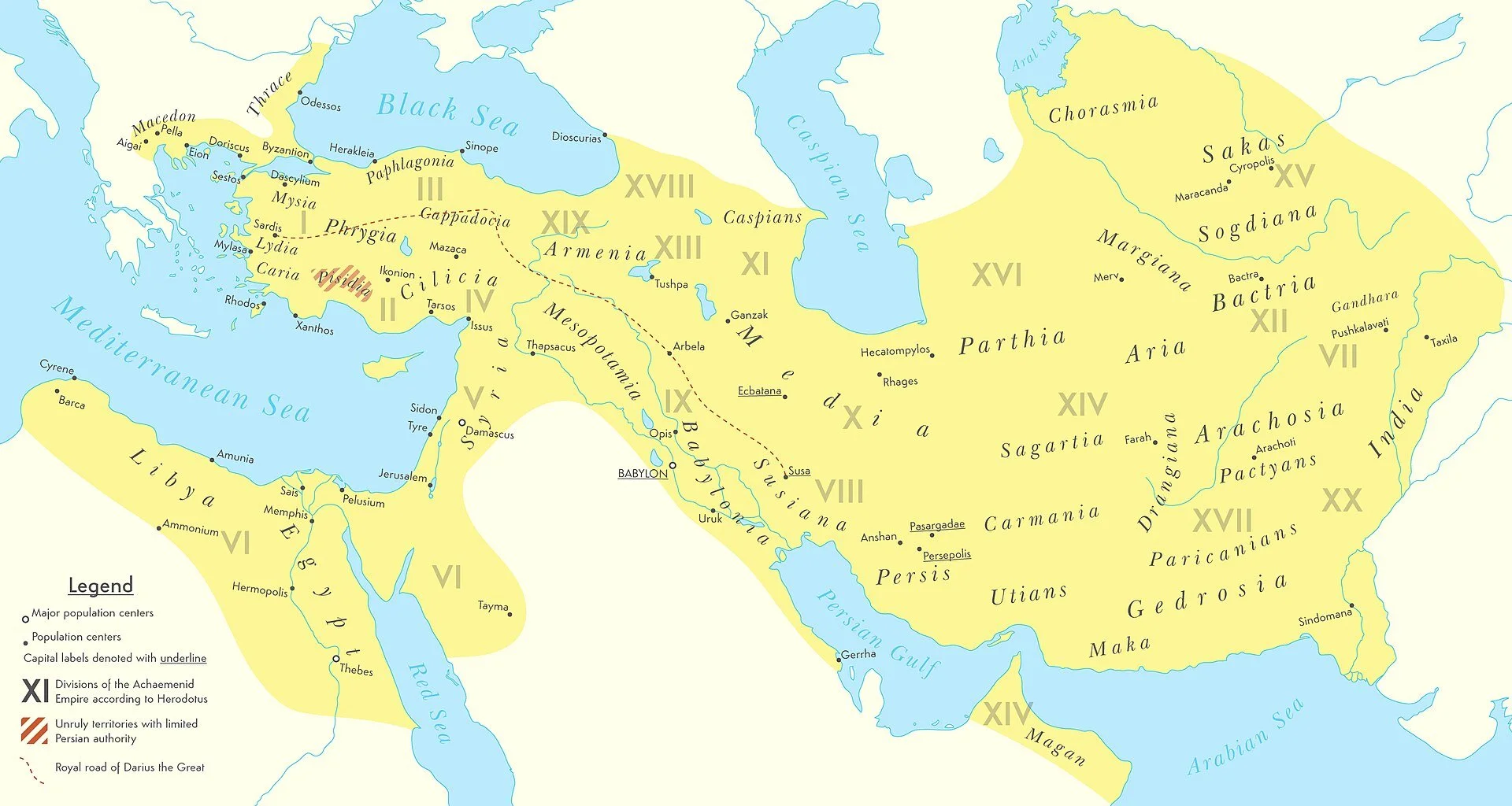
The Achaemenid Persian Empire at its height, around 500 BC, showing the twenty satrapies and the Royal Road of Darius the Great
Cattette, CC BY 4.0 <https://creativecommons.org/licenses/by/4.0>, via Wikimedia Commons
· Persepolis, ‘the city of the Persians,' was built as a ceremonial capital. The complex included vast audience halls, elaborate staircases carved with relief images of delegations from every corner of the empire bringing tribute to the king, and royal palaces decorated with gold, ivory, and cedar. Its ruins are a UNESCO World Heritage site and remain among the most impressive in the world.
· The Behistun Inscription was a monumental inscription carved into a cliff face 300 feet above the ground. It recorded his military victories and the account of how he came to the throne. It was written in Old Persian, Elamite, and Babylonian. It is also a UNESCO World Heritage site.
· The Royal Road was a highway stretching roughly 1,500 miles from Susa in western Iran to Sardis on the Aegean coast of modern Turkey. The road reduced travel time from months to days. The unofficial motto of the United States Postal Service, "Neither snow nor rain nor heat nor gloom of night stays these couriers from the swift completion of their appointed rounds”, was drawn from Herodotus's description of the Persian message system along this road.
· The Darius Canal was a forerunner of the Suez Canal, connecting the Nile River to the Red Sea. It remained open for over 1,000 years. Darius placed several steles (markers) along its path. One has the following inscription: “King Darius says: I am a Persian; setting out from Persia, I conquered Egypt. I ordered to dig this canal from the river that is called Nile and flows in Egypt, to the sea that begins in Persia. Therefore, when this canal had been dug as I had ordered, ships went from Egypt through this canal to Persia, as I had intended.” The Louvre museum in France houses this stele.
Darius also created a governance model for vast, diverse empires by dividing the empire into twenty provinces, called satrapies. Each was led by a satrap who collected taxes and maintained order. Local people were allowed to maintain their own laws, languages, and customs. It was so effective that Alexander the Great maintained the system after conquering the Persian empire, and it may have served as a model for the Roman province system hundreds of years later.
Darius and the Bible
The story of the Jewish people under Darius is told in the Old Testament books of Ezra and Daniel. Ezra reaffirms Cyrus’s decree to rebuild the Jerusalem Temple at Persian expense, and anyone interfering will be put to death:
“…let the governor of the Jews and the elders of the Jews build this house of God in his place… that of the king's goods, even of the tribute beyond the river, forthwith expenses be given unto these men…that whosoever shall alter this word, let a beam be pulled from his house, and being set up, let him be hanged thereon.”
The Temple was completed in 516 BC, in the sixth year of Darius's reign.
The Book of Daniel tells the story of the lion’s den. Daniel was an important official under Darius. His rivals persuaded Darius to issue a decree forbidding prayer to any God or man other than himself. Anyone who violates “shall be cast into the den of lions.”
When the officials reported to Darius that Daniel continued to pray to the God of Israel, Darius reluctantly cast Daniel into the den.
The next morning, the King went to the den and found that Daniel had survived the night in the den. Daniel said,
“My God hath sent his angel, and hath shut the lions' mouths, that they have not hurt me…”
Darius then threw Daniel's accusers into the den and issued a decree ordering his subjects to honor Daniel's God.
The Invasion of Greece
In 499 BC, Greeks living along the coast of Asia Minor (modern Turkey) rebelled against Persian rule. Athens supported the rebellion by sending ships and troops. After Darius suppressed the revolt, he sought revenge against Greece.*
In 490 BC, Darius sent a fleet across the Aegean with a large army. After sacking several cities, the force landed at Marathon, a plain about 25 miles north of Athens. Although significantly outnumbered, the Greeks attacked and routed the Persian army, killing an estimated 6,400 Persians while losing fewer than 200 of their own men.
According to legend, a runner named Pheidippides was sent from Marathon to Athens to announce the victory. He ran the roughly 25 miles, burst into the assembly, declared "We have won," and died on the spot. The modern marathon race commemorates that run**.
Darius died in 486 BC before he could launch another invasion. The story of that invasion led by his son Xerxes will be told in Part 4.
* The Greek community survived in Asia Minor for over 2,400 years until 1922, when they were expelled in the aftermath of the Greco-Turkish War.
**The modern marathon distance of 26.2 miles was standardized at the 1908 London Olympics, when a route was picked to satisfy royal viewing preferences.