History of Iran - Part 20
The current situation in the Middle East has focused attention on Iran — a country whose history rivals that of any on earth, stretching back over 5,000 years and encompassing 29 UNESCO World Heritage sites. UNESCO (United Nations Educational, Scientific and Cultural Organization) defines a World Heritage Site as a landmark or area recognized for its outstanding cultural, historical, or natural significance and protected under an international treaty for the benefit of all humanity.
This is part 20 of a multi-part series examining that history.
Click here for a list of the articles in this series.
The Mongol Empire Divides
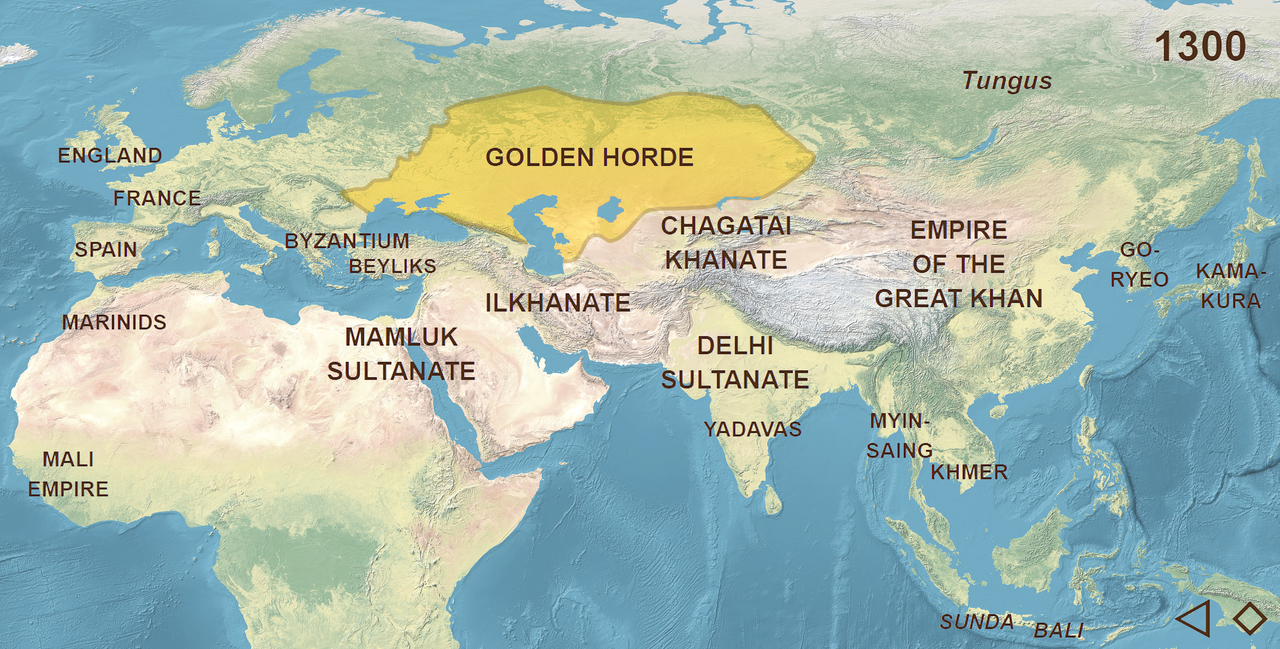
Map showing the Division of the Mongol Empire
(Public Domain- CC0)
When Genghis Khan died in 1227, the empire was divided among his sons. During his lifetime, he had assigned territories to the four sons of his principal wife, Börte. The eldest, Jochi, died the same year as his father, but his line kept the lands in the far west. His second son, Chagatai, presided over lands in Central Asia. An assembly of Mongol leaders chose the third son, Ögedei, as Great Khan, succeeding Genghis as overlord of the Mongols. The youngest son, Tolui, held the Mongol homeland.
Tolui's sons matter for our story. They included Möngke, Kublai, Ariq Böke, and Hulegu.
At first, the division was loose, and the other branches nominally answered to the Great Khan in Mongolia. After Möngke died in 1259, his brothers Kublai and Ariq Böke fought a civil war that ran from 1260 to 1264. By the end of that decade, the empire had become four rival khanates, each with its own course:
The Yuan Dynasty in China was founded by Kublai. It lasted almost 100 years until the Ming Dynasty conquered it. It was the first non-Han dynasty to rule all of China.
The Golden Horde, descended from Jochi through his son Batu, ruled the Russian steppe, and marked the empire's westernmost reach. The name is believed to come from the Mongolian word for a camp or palace, and "golden" may refer to a khan's golden tent or his court’s wealth.
The Chagatai Khanate, named for Genghis's second son, held Central Asia.
The Ilkhanate in Iran, ruled by Hulegu’s descendants.
Hulegu and the End of Alamut
The Nizari Ismaili state, headquartered in the fortress of Alamut and home of the Assassins, had survived both the Seljuks and the Khwarazmians. But it did not survive the Mongols, who conquered it in 1256 under Hulegu’s leadership. Although the state was destroyed, the Nizari Ismaili branch of Shia Islam survived. It is estimated that over 12 million live in Asia, the Middle East, and Africa, along with a western diaspora.
Westward Expansion Halted
As mentioned in an earlier essay, Hulegu took Baghdad in 1258, brutally ending the Abbasid Caliphate there, after about 500 years as the symbolic center of the Islamic world. Hulegu then turned toward Syria. Aleppo fell after a short siege, and Damascus soon after. By early summer 1260, the Mongols were approaching Egypt's frontier. There they met the Mamluks.
The word mamluk means "owned," and Mamluks were slave soldiers. Rulers across the Islamic world bought boys, often from the steppe, converted them to Islam, and trained them as elite soldiers. In Egypt, the arrangement backfired, and they took control in 1250. Their sultanate lasted over 250 years until the Ottoman conquest of 1517.
When Möngke, Hulegu’s brother, died, Hulegu withdrew most of his army, leaving a reduced force under Kitbuqa. On 3 September 1260, at Ain Jalut in Palestine, the Mamluks defeated the Mongol force, and Kitbuqa was killed, ending the Mongol westward expansion.
The Ilkhanate
Hulegu moved to Persia and made his base in Azerbaijan. His state was called the Ilkhanate, from the title Ilkhan, often explained as “subordinate khan.” Rivals surrounded the new state: the Mamluks to the west, the Golden Horde to the north, and the Chagatai Khanate to the east.
Hulegu’s cousin Berke, the ruler of the Golden Horde, was one of the first Mongol rulers to convert to Islam. According to Persian historian Rashid al-Din Hamadani, Berke was outraged by Hulegu’s conquest of Baghdad. Rashid reports that Berke said Hulegu had destroyed Muslim cities, killed the Caliph, and spilled innocent blood. He wanted to punish Hulegu for these acts.
Berke allied with the Egyptian Mamluks and went to war against Hulegu in 1262. The Mamluks and Ilkhanate fought on and off for over 60 years until they signed a peace treaty in 1322/1323.
Ghazan

Noah’s Art from the Jami' al-tawarikh, Part of the Historical Narrative of the Book
Khalili Collections / CC-BY-SA 3.0 IGO
Ghazan was Hulegu’s great-grandson and became the seventh Ilkhanate ruler of Persia in 1295. His uncle Gaykhatu had been the ruler, and his attempt to introduce paper money failed. Gaykhatu then insulted his kinsman Baydu while drunk. Baydu, who had been considered for the Ilkhanate when Gaykhatu was chosen, started a revolt. Gaykhatu was killed. Baydu became ruler, but only briefly, as his relative, Ghazan, wanted power. Ghazan converted to Islam at this time. Historians think part of the motive may have been to win support from Muslim Mongol officers on both sides. He won the resulting conflict and executed Baydu. Islam now became widespread among the Mongols.
Ghazan executed many of his opponents and continued the wars against the Mamluks. After an initial repression of non-Muslims, he tolerated multiple religions and kept the Mongol ‘Yasa’ code of laws.
His most lasting legacy may be a book. Ghazan's Mongols had adopted Persian customs, but he still wanted them to remember their steppe roots, so he asked his vizier (prime minister) Rashid al-Din to write a history of the Mongols. After Ghazan's death, his successor, Öljeitü, asked Rashid al-Din to expand it into a history of the whole known world, from China to Europe. That work, called the Jami' al-tawarikh, or Compendium of Chronicles, is lavishly illustrated.
The End of the Ilkhanate
After Ghazan’s death in 1304, his successors struggled to hold the state together. His brother Öljeitü succeeded him, followed by Öljeitü’s son, Abu Said. When Abu Said died in 1335 without an heir, the Ilkhanate broke into rival successor states. About half a century of fragmentation followed until a new force, Timur (Tamerlane), arose from the east, bringing us to the next chapter in Iran's history.