History of Iran - Part 19
The current situation in the Middle East has focused attention on Iran — a country whose history rivals that of any on earth, stretching back over 5,000 years and encompassing 29 UNESCO World Heritage sites. UNESCO (United Nations Educational, Scientific and Cultural Organization) defines a World Heritage Site as a landmark or area recognized for its outstanding cultural, historical, or natural significance and protected under an international treaty for the benefit of all humanity.
This is part 19 of a multi-part series examining that history.
Click here for a list of the articles in this series.
The Mongol Invasion
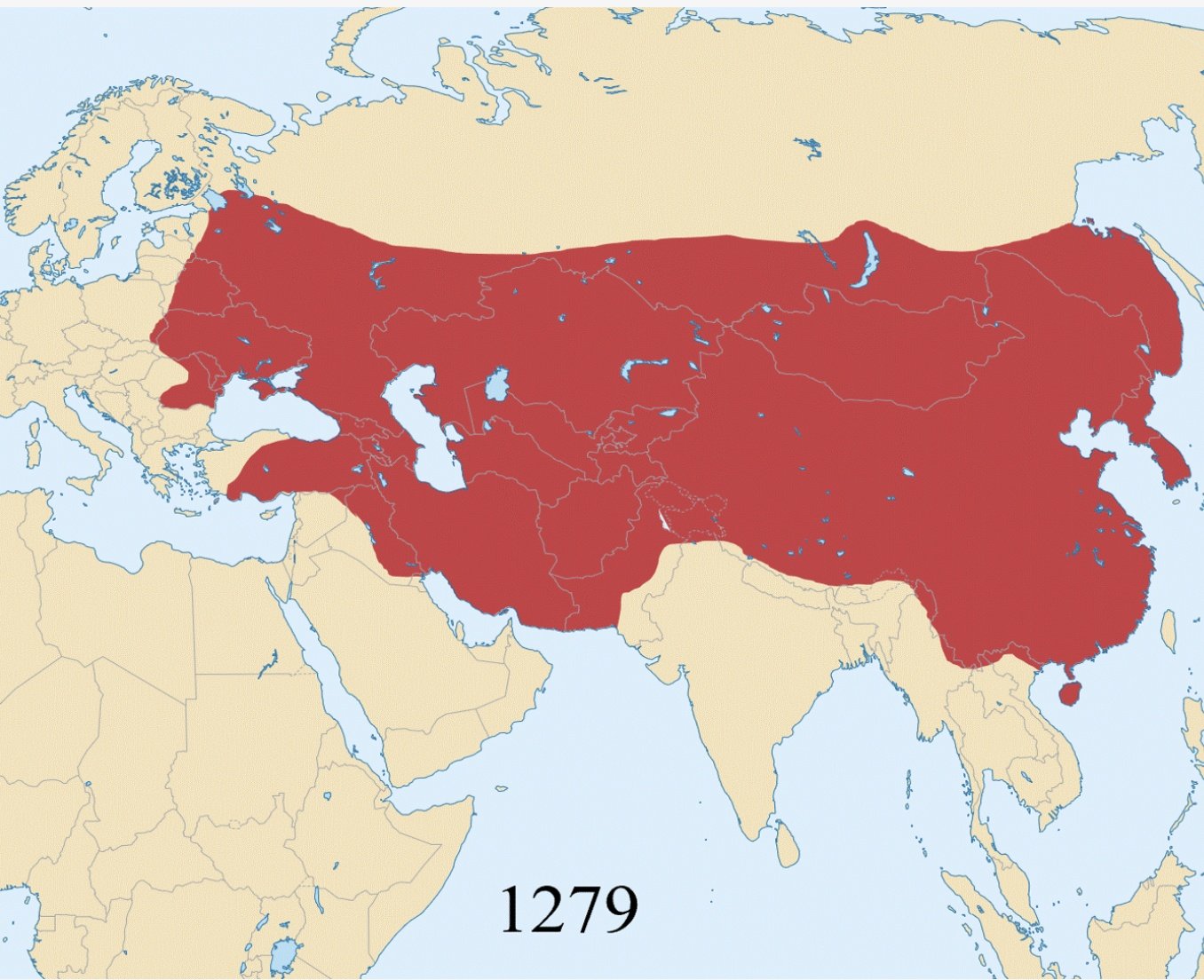
Mongol Empire at its Greatest Extent, c 1279
DannamEmpire, CC BY 4.0 via Wikimedia commons
Most people know the Mongols for one thing: cruelty. The destruction they brought to Iran was real and enormous, arguably the worst catastrophe in the country's recorded history. The story of their conquest of Iran begins with a trade dispute and a ruler who badly misjudged his opponent.
Who Were the Mongols?
The Mongols were nomadic herders from the steppe of what is now Mongolia, living off horses, sheep, and goats. They were a patchwork of rival tribes that constantly raided and fought each other. The wealthy Jin dynasty of northern China played them against one another and demanded tribute.
Born around 1162 as Temüjin, the future Genghis Khan was, according to tradition, left poor and abandoned by his own clan after his father was killed. Through alliances, betrayals, and relentless warfare, he eliminated or absorbed his rivals. In 1206, an assembly of tribal leaders proclaimed him Genghis Khan, usually translated as “universal ruler.” Much of what we know of Genghis Khan’s early life comes from the Secret History of the Mongols, a near-contemporary Mongolian text that mixes fact and legend.
He reorganized the army, deliberately mixing members of former rival tribes so loyalty ran to the Khan rather than to the old clans. Promotion rewarded merit and loyalty, not birth. Mongol forces relied on speed, mounted archery, feigned retreats, and good intelligence. When they met walled cities, they used Chinese siege engineers and adapted. A relay messenger system, the yam, tied the empire together.
The Mongol Empire was the largest continuous land empire in history. They conquered China. They overwhelmed most of Russia, eventually reaching into Poland and Hungary. And, as discussed below, they subjugated most of Iran, extending into parts of modern-day Turkey. However, their attempts to conquer Japan failed when a typhoon (known by the Japanese as the ‘divine wind,’ or Kamikaze) destroyed their invasion fleet. At its largest, the Mongol Empire stretched from the Pacific coast of Asia to the borders of central Europe. Iran’s catastrophe was only one part of the Mongol journey.
Khwarazmian Empire
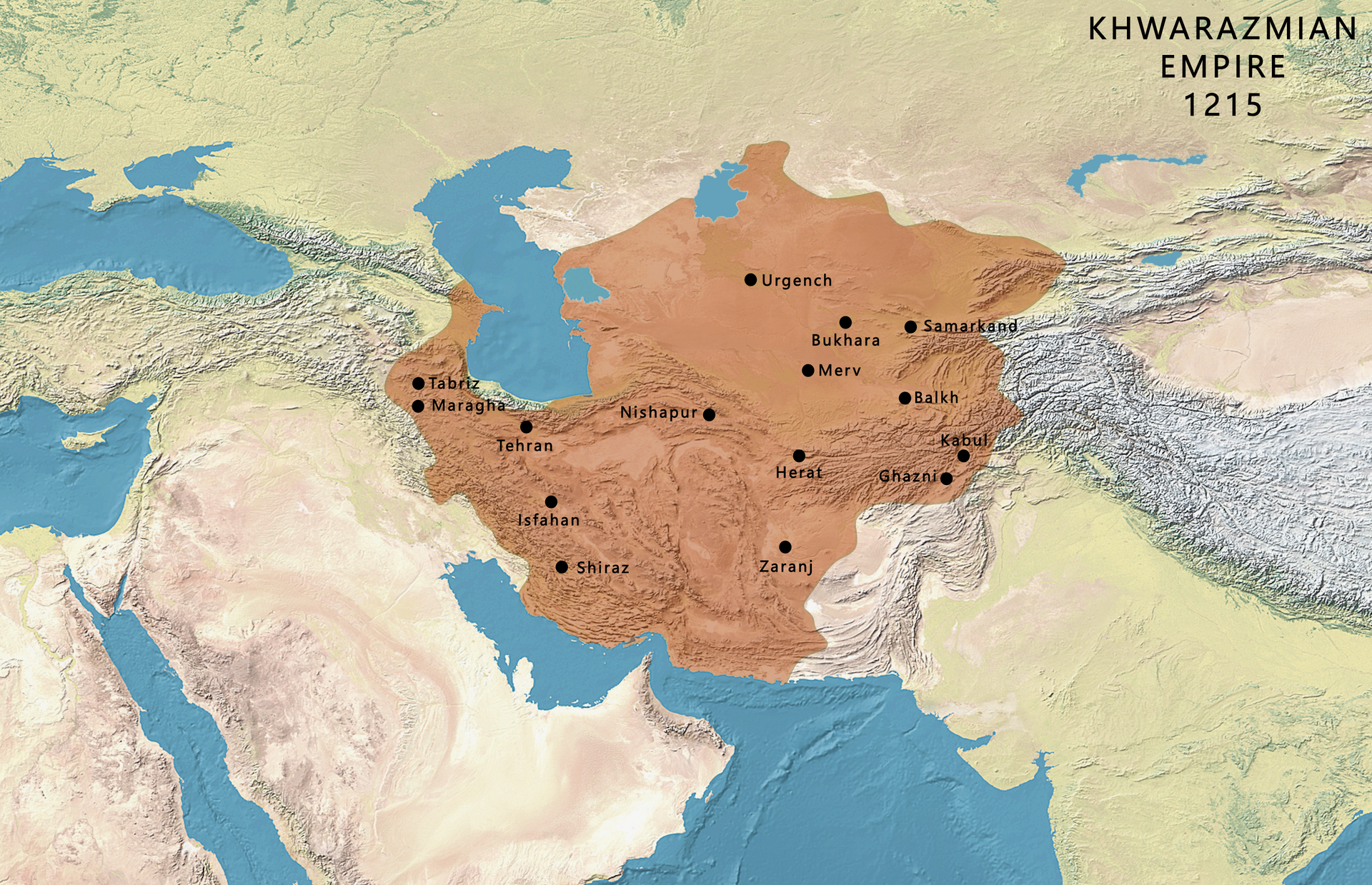
Khwarazmian Empire, c 1215
Arab League at English Wikipedia, CC BY-SA 3.0, via Wikimedia Commons
As discussed in a prior essay, after the assassination of Vizier Nizam al-Mulk and the death, possibly murder, of Sultan Malik-Shah (both in 1092), the Seljuk Empire dissolved into competing branches – an eastern sultanate based at Merv, in modern-day Turkmenistan; one at Hamadan in western Iran, and one in Anatolia known as the Sultanate of Rum.
Around the year 1077, the Seljuks appointed a former Turkic slave-commander as governor of Khwarazm, a region south of the Aral Sea. His descendants held the post hereditarily and, as Seljuk power faded, grew increasingly independent. The leaders were known by the title Khwarazmshah ('Shah of Khwarazm’), hence their dynasty was called the Khwarazmian Empire. After a complex series of battles and power struggles, the Khwarazmian Empire defeated and killed the last Seljuk sultan, Tughril III, in 1194. At its peak, the empire stretched to the borders of India.
The empire didn’t last very long.
The Spark at Otrar
In the early 13th century, the Mongol Empire and the Khwarazmian Empire shared a common border. Genghis Khan's first move toward this neighbor was commercial, not military. In 1218, he sent a large trade caravan to the Khwarazmian border city of Otrar (in modern Kazakhstan). The governor, Inalchuq, accused the merchants of spying and had them executed.
Genghis Khan initially responded with restraint. He sent ambassadors demanding that the governor be punished. In what must be one of the great blunders of history, Shah Muhammad II executed one of Genghis Khan’s ambassadors and humiliated the others by shaving their beards. Diplomacy was finished, and the Mongols decided to invade. It’s a matter of historical debate whether the conflict could have been avoided or was inevitable between two expanding empires.
The Invasion, Part I, 1219–1221
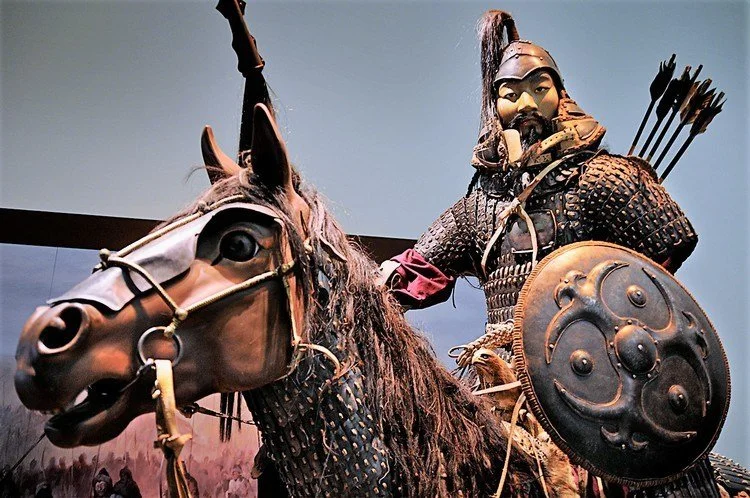
Mongol Warrior Reconstruction
William Cho, CC BY-SA 2.0 via Wikimedia Commons
Genghis Khan responded with a carefully prepared campaign. He gathered intelligence, brought siege engineers, and divided an army of roughly 100,000 into several columns that struck from different directions.
Otrar fell after a siege of about five months. In early 1220, Bukhara and then Samarkand, the Khwarazmian capital, fell (both cities are in modern-day Uzbekistan). Muhammad II fled west, chased by Mongol detachments, and died of illness on a small island in the Caspian Sea.
Genghis Khan's youngest son, Tolui, led a second force into the Khorasan region, which encompassed parts of Central Asia and eastern Iran. He devastated the cities of Merv (in modern Turkmenistan) and Nishapur (northeastern Iran). Herat (western Afghanistan) was initially spared but then destroyed after a revolt in 1222. These were three of the world's largest and wealthiest cities. Merv surrendered, thinking its residents would be spared, but was still subjected to a massacre. Contemporary chroniclers claimed over a million deaths in each city. While these figures may be exaggerated, the destruction was catastrophic. By 1221, organized Khwarazmian resistance had collapsed.
The Mongols used terror strategically: cities that surrendered were generally spared and taxed, while those that resisted were destroyed, so their reputation for brutality would persuade the next city to submit. But this wasn’t the case for Merv.
The Damage
The killing was only part of the damage. Iranian agriculture depended on qanats, underground channels that carried water from mountain aquifers to farmland and needed constant maintenance. Many were destroyed outright. Others simply silted up because the skilled workers who maintained them had been killed or scattered. The result was famine and the breakup of Iran's once continuous settlement into isolated oasis towns. In some areas, instead of agriculture, nomads used the land for grazing. Estimates vary, but the region’s population fell drastically after the invasion.
Genghis Khan’s Death
Genghis Khan died in 1227, but the Mongol advance did not end. In the 1250s, his grandson Hulagu led a second wave into the Middle East and took Baghdad in 1258. The last Abbasid caliph, al-Musta'sim, surrendered the city after a brief siege. He was murdered by the Mongols, along with a significant portion of the city’s population. The Mongols destroyed libraries, palaces, and the House of Wisdom*. According to some sources, they threw so many manuscripts into the Tigris River that the river ran black with ink. Or maybe the river ran red from the massacre. However described, it was a cataclysm. The fall of Baghdad ended the Abbasid Caliphate, the symbolic center of the Islamic world for about 500 years.
Genghis Khan's descendants soon divided the empire. Iran fell to the branch known as the Ilkhanate, whose rulers, as we will show, would eventually do what earlier conquerors of Iran had done: adopt Persian culture and govern in Persian ways.
* The House of Wisdom contained a large library of works translated from Greek, Persian, Indian, and Syriac sources into Arabic.