History of Iran - Part 21
The current situation in the Middle East has focused attention on Iran — a country whose history rivals that of any on earth, stretching back over 5,000 years and encompassing 29 UNESCO World Heritage sites. UNESCO (United Nations Educational, Scientific and Cultural Organization) defines a World Heritage Site as a landmark or area recognized for its outstanding cultural, historical, or natural significance and protected under an international treaty for the benefit of all humanity.
This is part 21 of a multi-part series examining that history.
Click here for a list of the articles in this series.
How We Know the Past
Much of what we know about the past comes from historians who wrote it down: Herodotus, a Greek historian from the 5th century BCE, wrote Histories, an account of the Persian Empire and the wars with Greece. Thucydides, another Greek historian, gave us an account of the Peloponnesian War, the conflict between Athens and Sparta. Livy, a Roman historian, wrote the History of Rome, covering the period from Rome's founding in the 8th century BCE into the reign of Augustus, including an account of the Punic Wars against Carthage. Tacitus provides a narrative of Roman history after Augustus's death. And in 915 CE, Islamic scholar al-Tabari completed a history called the History of the Prophets and Kings. It focused on the Middle East, covering ancient Israel, Persia, and the spread of Islam.
This essay looks at one more work in that tradition, written in Mongol-ruled Iran: the Jami’ al-tawarikh, or Compendium of Chronicles. It has been called the first truly global history. You have already seen part of it, since the miniature of the siege of Baghdad in Part 19 comes from a later copy.
A Vizier Writes History
Its author, Rashid al-Din, was born around 1247 in Hamadan into a Jewish family. He trained as a physician, converted to Islam around 1278, and rose in government service. Ghazan, ruler of the Ilkhanate, appointed him vizier.
Ghazan commissioned Rashid al-Din to write a history of the Mongols. After Ghazan's death in 1304, his brother and successor, Öljeitü, asked Rashid al-Din to expand it into a history of the whole known world. The work was completed sometime between about 1306 and 1311, and the first part was presented in Ghazan's name. It was produced in both Arabic and Persian.
Rashid al-Din founded the Rab’-i Rashidi in Tabriz (in modern-day Iran), a place where scribes and artists produced books. Writing the book was likely a collective effort overseen by Rashid al-Din.
The Book’s Contents
Only portions of the book survive.
The first sections start with the Turkic people and tribes of the steppe. The Mongol sections then trace the family of Genghis Khan, his life, and the reigns of his sons, grandsons, and successors, and continue through Ghazan and Öljeitü’s accession.
The world-history sections start with Adam and continue to about 1300, when Rashid al-Din was writing. He covers the nations of the world known to him, including China, India, the Jews, and the Franks (Persians referred to Western Europeans as Franks).
The European section draws on the Chronicon pontificum et imperatorum, a chronicle of popes and emperors by the Dominican friar Martin of Opava. Rashid al-Din’s Chinese section probably used information from Buddhist and Chinese contacts. The Jewish sections likely drew on his own education.
The Paintings
The surviving illustrated copies were lavishly decorated. Some paintings show Mongol soldiers, Ghazan’s conversion to Islam, and the siege of Baghdad. Others show the Buddha and the landscape between India and China, and Noah and the Ark.
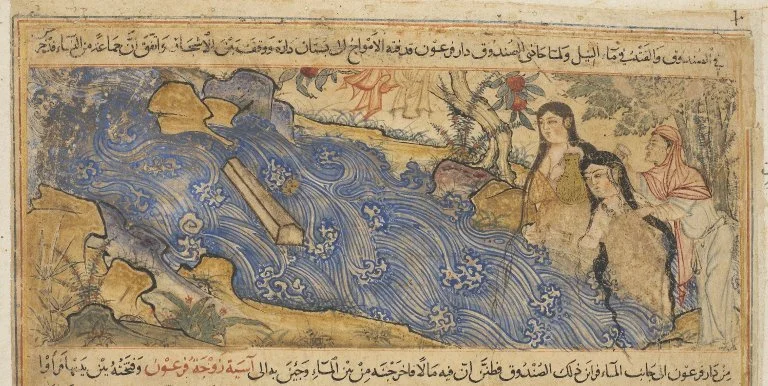
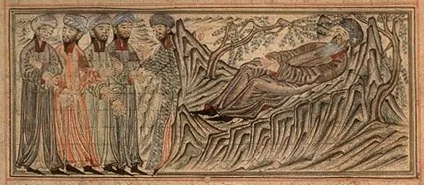
One figure drew special attention: Moses. The paintings show his discovery as an infant in the Nile, his meeting with God on Mount Sinai, the drowning of Pharaoh's army, his fight with the giant Og, the punishment of the Golden Calf worshipers, and his death on Mount Nebo.
Why so much attention to Moses? Rashid al-Din's Jewish background may have played a part. Moses (Musa in Arabic) is a revered prophet in Islam. Moses is one of the most frequently mentioned individuals and prophets in the Quran. His life story is told throughout the Quran. The Quran describes him as ‘Kalim Allah,’ meaning ‘The one whom Allah spoke to.’ He is traditionally considered one of the Five Great Prophets. The others are Noah, Abraham, Jesus, and Muhammad.
Here are three of them. Click to each to view full screen. (All images are public domain via Wikimedia Commons)

Death of the Author
Rashid al-Din's account of the Mongol rulers remains our most important source for the Mongol era in Iran.
Making copies of the book by hand was likely a slow process. Rashid al-Din wanted two copies made per year, one in Arabic and one in Persian. In 1318, under Öljeitü's son Abu Said, he was accused of poisoning Öljeitü and executed. Some accounts say rivals used his Jewish background against him.
Copies of the book continued to be made. In 15th-century Herat, artists made richly illustrated copies for the Timurid dynasty, whom we will meet next. And around 1596, Akbar, the Mughal* emperor (located in the Indian subcontinent), commissioned an illustrated extract on Genghis Khan’s family, called the Chingiznama. He claimed descent wanted to reinforce his legitimacy by highlighting ancestral roots to the world's most renowned conqueror.
*Mughal is the Persian word for Mongol