History of Iran - Part 18
The current situation in the Middle East has focused attention on Iran — a country whose history rivals that of any on earth, stretching back over 5,000 years and encompassing 29 UNESCO World Heritage sites. UNESCO (United Nations Educational, Scientific and Cultural Organization) defines a World Heritage Site as a landmark or area recognized for its outstanding cultural, historical, or natural significance and protected under an international treaty for the benefit of all humanity.
This is part 18 of a multi-part series examining that history.
Click here for a list of the articles in this series.
Checkmate!
Chess set from 12 century, Iran. The shah (king) is represented as a throne; the vizier (the equivalent of the queen) is a smaller throne; the elephant (bishop) has two tusklike protrusions; the horse (knight) has a triangular knob representing its head; the chariot (rook) is rectangular with a wedge at the top; and the pawns are faceted hemispheres with knobs. CLICK TO EXPAND
(Metropolitan Museum of Art - Public Domain)
What does it mean to be checkmated? According to Merriam-Webster, it means a situation where someone is completely defeated, thwarted, or rendered powerless, with no way to escape or recover. Military history provides examples – in the Revolutionary War, British General Cornwallis found himself surrounded on land and sea at Yorktown and had no choice but to surrender. Or the 1942-43 World War II battle of Stalingrad – the Russians surrounded the Nazi 6th Army, which also had to surrender. A final example – the 1954 battle of Dien Bien Phu. The North Vietnamese forced the French to surrender by trapping their forces in an isolated military base.
In chess, it means a player’s king is under attack and has no legal moves, ending the game. The word comes from the Persian phrase "shāh māt" (shah mat), which roughly translates to "the king is helpless"
From India to the Sasanian Empire
Chess is generally believed to have originated in India around the 6th century CE as a war-simulation game called chaturanga—literally "four divisions," representing infantry, cavalry, elephants, and chariotry, the direct ancestors of the pawn, knight, bishop, and rook. From India, the game traveled west into Sasanian Persia, arriving around 600 CE under a new name: chatrang.
The Kār-Nāmag-ī Ardašēr-ī Pāpagān (Book of the Deeds of Ardashir, Son of Papag) is a Persian story about Ardashir I, the founder of the Sasanian dynasty. The book lists chatrang as one of Ardashir’s accomplishments. Khūsraw ud Rēdag (Khosrow and the Page) is a book written in the 6th century CE about an orphan who demonstrates his wisdom to the King. It shows what the Sasanians valued and includes chatrang as one of the disciplines a noble should learn.
The Royal Challenge
Illustration from a 16th century Shahnama, showing Buzurjmihr Mastering the Hindu Game of Chess. CLICK TO EXPAND
(Metropolitan Museum of Art - Public Domain)
The book, Vijârishn ī Chatrang (Explanation of Chess) was written in the late 6th century CE. According to the story, an Indian king named Divsaram sent an elaborate chess set to the court of Khosrow I consisting of sixteen pieces carved from diamond and sixteen from ruby. It was escorted by 1,200 camel-loads of gold, silver, and jewels, and ninety elephants. Along with the gift came a challenge: solve the game's rules, or Persia would owe tribute to India. A Persian sage named Bozorgmehr solved the game, demonstrated it, and described how the Indian king had modeled the pieces on real battle formations. He then defeated the Indian ambassador three times.
Bozorgmehr then sent a counter challenge back to India based on a new game he created. He built the game as a working model of the universe. The board represented the earth; its thirty pieces stood for the thirty days of the month. Black and White pieces represented duality such as day and night or good and evil. The roll of dice echoed the turning of the stars and the zodiac. When a piece was captured and removed from play, it represented a soul passing from this world — and when the pieces were gathered up and set again for a new game, that represented the resurrection of the dead at the end of time. He challenged the Indians to solve this game, and they couldn’t. The game – Nard – Persian backgammon is still played in Iran and other neighboring countries. Modern backgammon is descended from Nard, although its rules differ.
The story echoed down through Persian literature long after Bozorgmehr's own lifetime. Centuries later, Omar Khayyam, the poet-astronomer author of the Rubaiyat, used an image of chess as a metaphor for fate itself, in one of his quatrains:
‘Tis all a Chequer-board of Nights and Days
Where Destiny with Men for Pieces plays:
Hither and thither moves, and mates and slays,
And one by one back in the closet lays.
Legend? History? A mix of both?
Ferdowsi and the True Meaning of "Checkmate"
As covered in part 15 of this series, the poet Ferdowsi wrote an epic poem covering Iran’s history, known as the Shahnameh (“Book of Kings”). He retells this same story of chess arriving from India during Khosrow I's reign, but adds a myth explaining the origin of the term checkmate.
According to Ferdowsi, two half-brothers, Talhand and Gav, went to war over the throne of India. In the fighting, Talhand died atop his elephant without a wound. His mother is upset, believing that Gav murdered Talhand, although he denies it. So the court's sages built a game to show her what had happened. Using carved pieces to re-enact the battle, they demonstrated that Talhand had simply been surrounded on all sides, with no path of retreat, and died of sheer exhaustion. This, tradition holds, is the origin of the game's final phrase — checkmate (shah mat in Persian), meaning the king is not dead, but trapped, with nowhere left to go.
The Islamic World and Chess
When Arab forces conquered Persia in 651, chess passed into the wider Islamic world along with the rest of Sasanian court culture. In Arabic, the game became known as Shatranj. Nearly every piece name survived the transition almost untouched: shah (king), rukh (rook, meaning chariot), fil (elephant/bishop), faras (horse/knight), firzan (counselor, the ancestor of the queen), and baidaq (foot soldier/pawn).
Chess continued to flourish under Islamic patronage. The earliest well-documented Shatranj master, al-Adli, lived in the 9th century CE and was considered the era's supreme player. His book Kitab ash-Shatranj (Book of Chess) was the most comprehensive chess work produced up to that time. The greatest Shatranj player of the Islamic Golden Age, Abu Bakr Muhammad ibn Yahya as-Suli, born in 880 CE, defeated al-Adli’s best students and remained unbeaten for decades. He also wrote several strategy books.
The game spread into Europe through Muslim Spain and Sicily, then into the rest of Europe, where it evolved into chess.
From Shatranj to Modern Chess
Shatranj was a noticeably slower, more cautious game than modern chess because the pieces were less powerful. European players in the 14th and 15th centuries modified the rules. For example, the firzan could only move 1 square diagonally. The firzan became the Queen and became the most powerful piece, able to move across the board horizontally, vertically, and diagonally.
Dilaram’s Puzzle
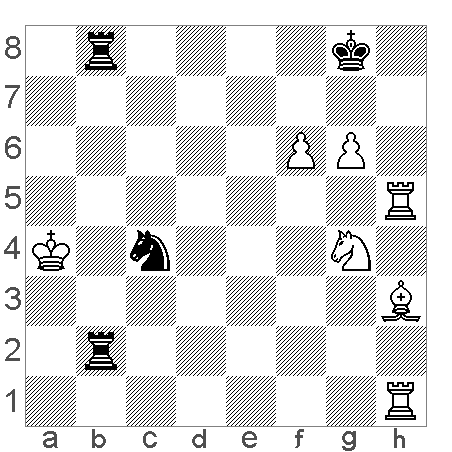
Dilaram’s Puzzle (CC BY-SA 3.0)
"Dilaram's mate" became one of the most famous mansubat (composed problems) in the entire Islamic chess tradition, most likely originating with as-Suli himself in the 10th century. Its reach went beyond the Islamic world: it appears with illustrations in the 13th-century Spanish Libro de los juegos (“Book of Games”), commissioned by King Alfonso X of Castile. The story is also retold in a 16th-century Polish poem by Jan Kochanowski entitled Szachy (“Chess”).
In the story, a nobleman's favorite wife was named Dilaram—Persian for "heart's ease" —because, as the old tale puts it, his heart knew no peace without her. One day, playing shatranj against a very strong opponent, he staked everything and kept losing until, finally, with nothing left to bet, he staked Dilaram herself.
The game turned disastrous. His opponent had what looked like a certain, unstoppable checkmate on the very next move. At that moment, Dilaram, watching and about to lose her freedom over a board game, cried out: "Sacrifice your two Rooks, and not me!"
Her husband saw what she meant, forced checkmate, and saved his wife!
If you'd like to try your hand at the actual position and see whether you can spot the winning sacrifice, The Chess Variant Pages has preserved the full historical problem, including the rule differences compared to modern chess.
Checkmate!
What never changed, through fourteen centuries and a half-dozen languages, is the phrase Ferdowsi's sages supposedly coined to describe a king with nowhere left to run. Shah Mat (Persian), echec et mat (French), scacco matto (Italian), jaque mate (Spanish) all mean the same thing – Checkmate – a King that has no moves.