To the Victor Goes the Spoils - Part 4
The recent Netflix series, ‘Death by Lightning,’ covered the life and death of President Garfield and his assassin, Charles Guiteau. A significant issue at the time was governmental corruption through the patronage (spoils) system. Guiteau himself was a disappointed job seeker - he wanted a job in the Garfield administration.
The first three articles of this multi-part series covered the history of the spoils system, starting with its origins under President Andrew Jackson, continuing with the numerous scandals during President Grant’s terms, and through the start of reform under President Rutherford Hayes. This part covers the assassination of President Garfield by a disappointed office seeker, directly leading to Civil Service reform.
James A. Garfield (1881)
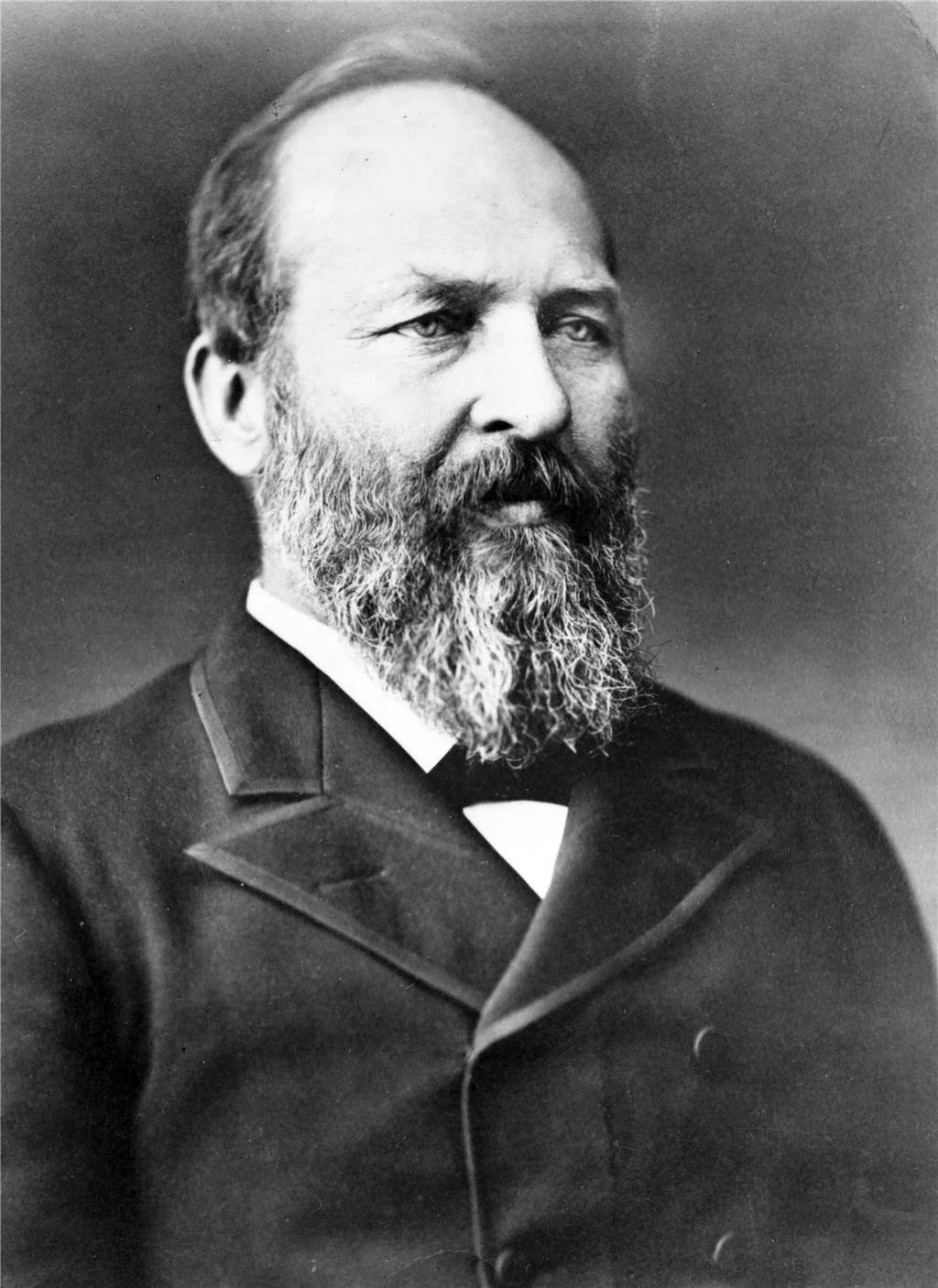
President Garfield
After Rutherford Hayes honored his pledge to serve only one term, the Republican Party was deeply divided into several factions. One group was called the ‘Stalwarts,’ who defended the spoils system as protecting the party's power. This group supported U.S. Grant for a third term as President.
The second group was called the ‘Half Breeds.’ This name was given to them by the Stalwarts, claiming they were only half-republican. They supported civil service reform. They put forth James Blaine, Senator from Maine.
John Sherman, the younger brother of William Tecumseh Sherman, the famous Civil War general, was offered as a compromise candidate between the two other factions.
Sherman was nominated by Ohio Congressman Garfield. His nomination speech inspired the convention (full text here - you may have to skip a PBS ad)
In the speech nominating Sherman, Garfield appealed to higher morals and the Republican Party’s role in saving the Union, rising above partisanship. “At that crisis [referring to the Civil War], the Republican Party was born. It drew its first inspiration from that fire of liberty which God has lighted in every human heart…It entered the arena where the…Territories were struggling for freedom, and drew around them the sacred circle of liberty, which the demon of Slavery has never dared to cross…Every slave-pen and the shackles of every slave within the shadow of the Capitol were consumed in the rekindled fire of freedom.”
His speech inspired the delegates, with one shouting out, ‘We want Garfield!’ Garfield protested that he was not a candidate, ultimately to no avail.
The convention took 36 ballots, over three days, to name a Republican candidate. Only a few votes changed on the first 35 ballots. Grant won more votes than any other candidate, but not the majority needed to secure the nomination. Then on the 36th ballot, the delegates supporting Blaine and Sherman all switched to Garfield, making him the candidate. To balance the ticket and appease the Stalwarts, Chester Arthur, former head of the New York Custom House, whom President Hayes had dismissed, was selected for Vice President.
Garfield won the Presidency with the tightest popular vote margin in history – about 10,000 out of almost nine million cast. His narrow New York State vote margin of about 21,000 gave him the victory in the Electoral College.
Garfield was President for four months before he was assassinated and then lingered for 79 days before dying. In those four months, he initiated some actions towards Civil Service reform. Despite protests by Senator Conkling and the Stalwarts, Garfield appointed someone from the ‘Half Breed’ faction as Collector of the Port of New York, the most lucrative patronage post in the country.
Conkling resigned from the Senate in protest. At that time, the State Legislature, not the public, elected Senators. Conkling believed the legislators would overwhelmingly send him back to the Senate, showing Garfield that he still had power in New York State, then the largest state in the country. His gamble backfired, as the legislators named Elbridge Lapham the new Senator. He wasn’t part of Conkling’s political machine. The incident showed Garfield’s desire to move away from patronage politics.
Garfield also confronted a postal scandal known as ‘Star Routes,’ which were deliveries to remote areas delivered by private contractors. The contractors colluded with postal officials to defraud the government. Garfield directed investigators to pursue the fraud aggressively, even though some Republicans were implicated. “I direct you not only to probe this ulcer to the bottom, but to cut it out.”
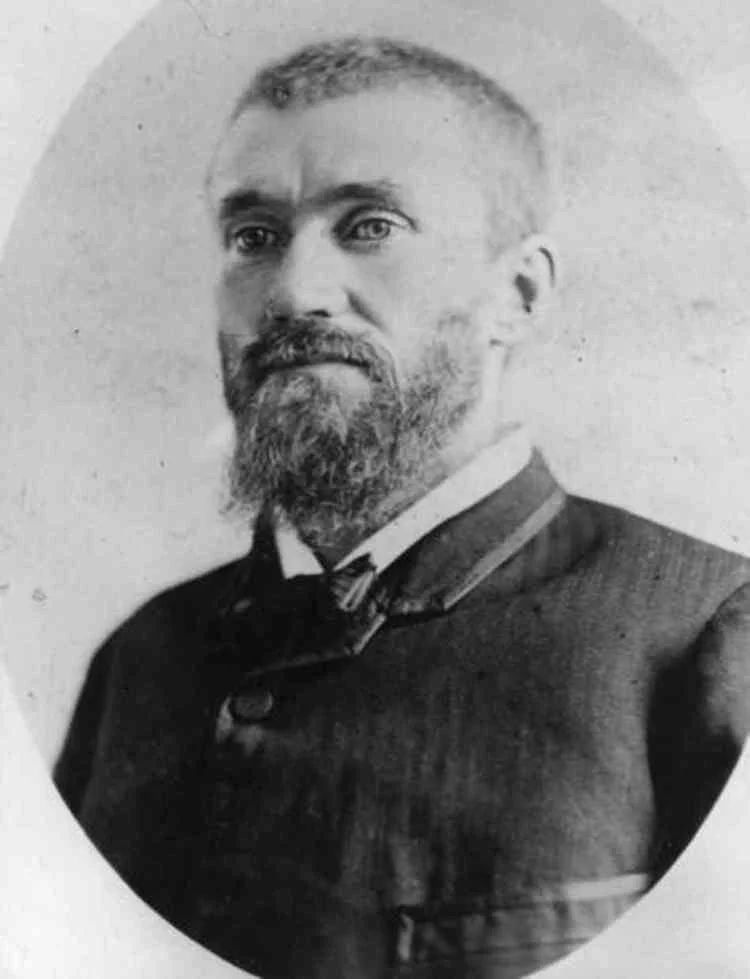
Charles Guiteau
Charles Guiteau was likely mentally ill and delusional. He wrote a pamphlet supporting Garfield against his Democratic opponent, Civil War general William Hancock. His pamphlet, entitled ‘Garfield against Hancock,’ essentially replaced ‘Grant’ with ‘Garfield’ from other Republican speeches and campaign literature. As a result, he gave Garfield credit for Grant’s accomplishments as General and President. He printed and distributed several hundred copies of the pamphlet and gave one or two speeches to small audiences.
He believed he played a significant role in Garfield’s narrow victory. As a result, under the spoils system, he thought he was entitled to a job. In those days, job seekers would personally visit government officials to ask for a position.
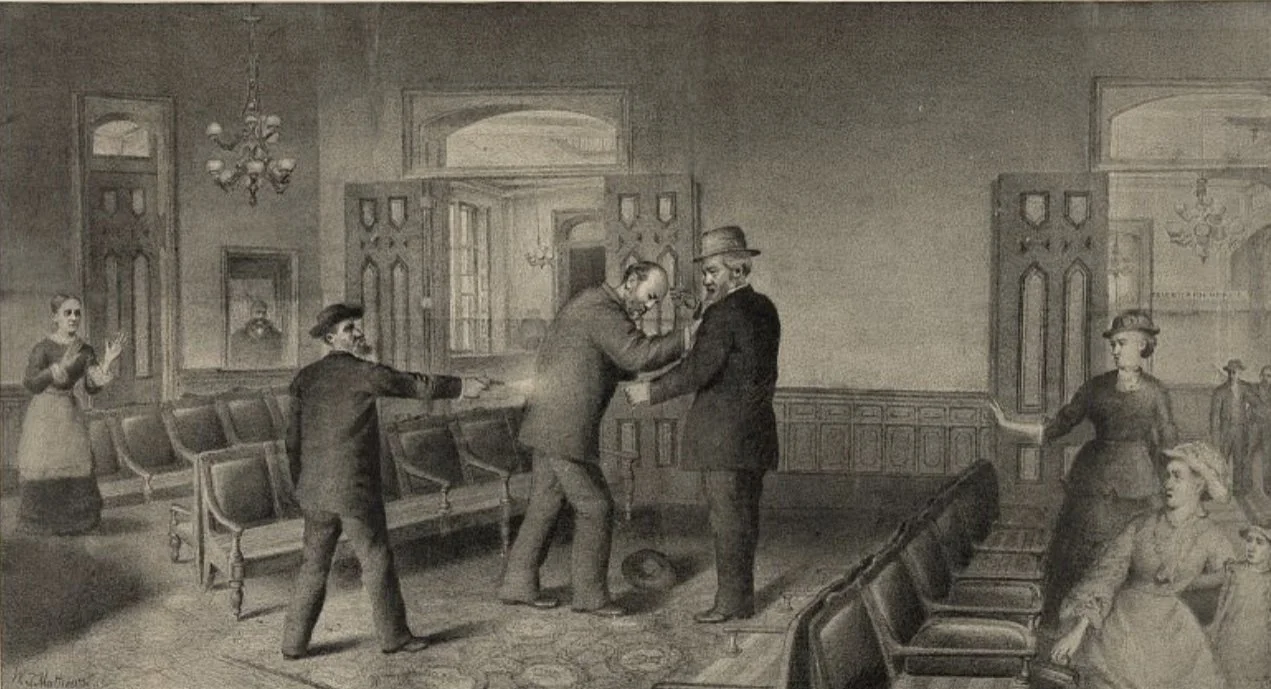
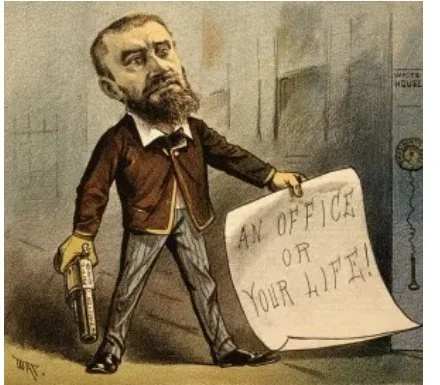
In the spring of 1881, he went to the White House and the State Department over 30 times, asking for a job. He handed out copies of his pamphlet to the Secretary of State, wrote letters to Garfield, and even once managed to shake Garfield’s hand at a reception.
Angry at Garfield and believing Vice President Arthur, a past supporter of the spoils system, would reward him, Guiteau waited for Garfield at the Baltimore and Potomac train station in Washington, DC. He shot Garfield twice, once in the arm, and the other in the back. He then shouted, “I am a Stalwart, and Arthur will be President!”
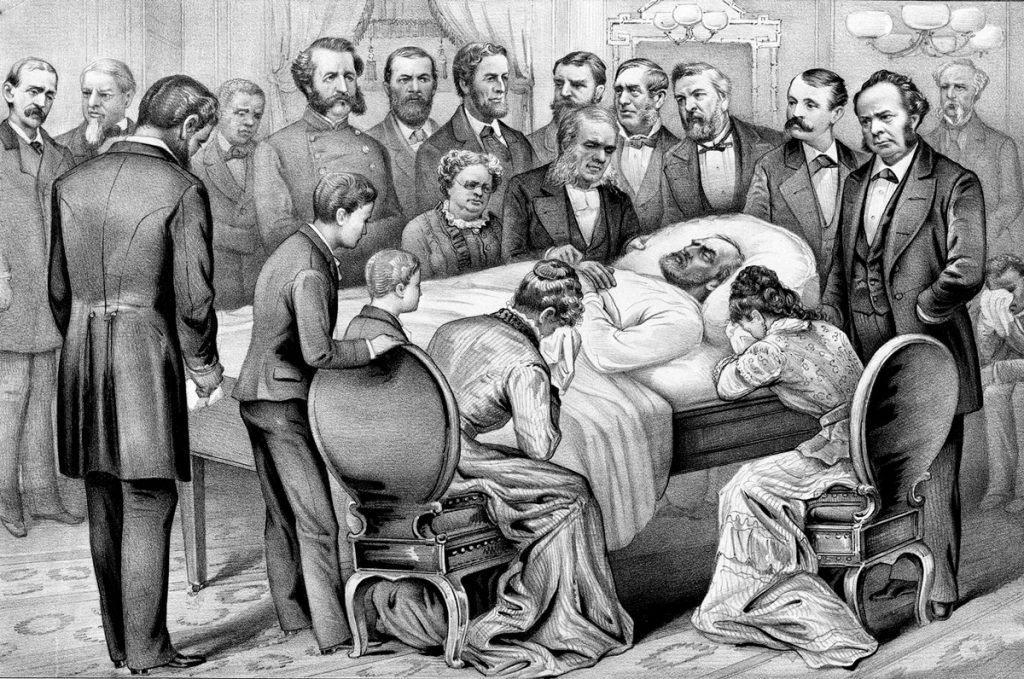
He was shot on July 2, 1881, and died 79 days later on September 19, 1881. Modern doctors believe the wounds were not fatal, and if Garfield’s doctors had left Garfield alone, he likely would have survived. Instead, their attempts to extract the bullet, without antiseptic practices, caused his death. Ironically, Robert Todd Lincoln, who had been present at his father’s deathbed, witnessed Garfield’s shooting.
As we will cover in the final part of this series, public outrage over the assassination directly led to the elimination of the spoils system through the Pendleton Civil Service reform bill.