History of Iran - Part 5
The current situation in the Middle East has focused attention on Iran — a country whose history rivals that of any on earth, stretching back over 5,000 years and encompassing 29 UNESCO World Heritage sites.
This is part 5 of a multi-part series that will examine that history.
Click here for a list of the articles in this series.
Artaxerxes I and the Peace with Greece
Artaxerxes I inherited the throne in 465 BC following the assassination of his father, Xerxes, and the killing of a rival brother. His forty-year reign was one of the longest in Achaemenid history.
Around 449 BC, he signed the Peace of Callias with Athens, formally ending the Greco-Persian wars that had defined the previous fifty years. Persia agreed not to send warships into the Aegean Sea and acknowledged Greek autonomy in Asia Minor. The empire that had twice invaded Greece was now formally recognizing limits on its power.
Artaxerxes and the Bible
The Book of Nehemiah is another chapter in the story of Persian tolerance towards the Jewish people.

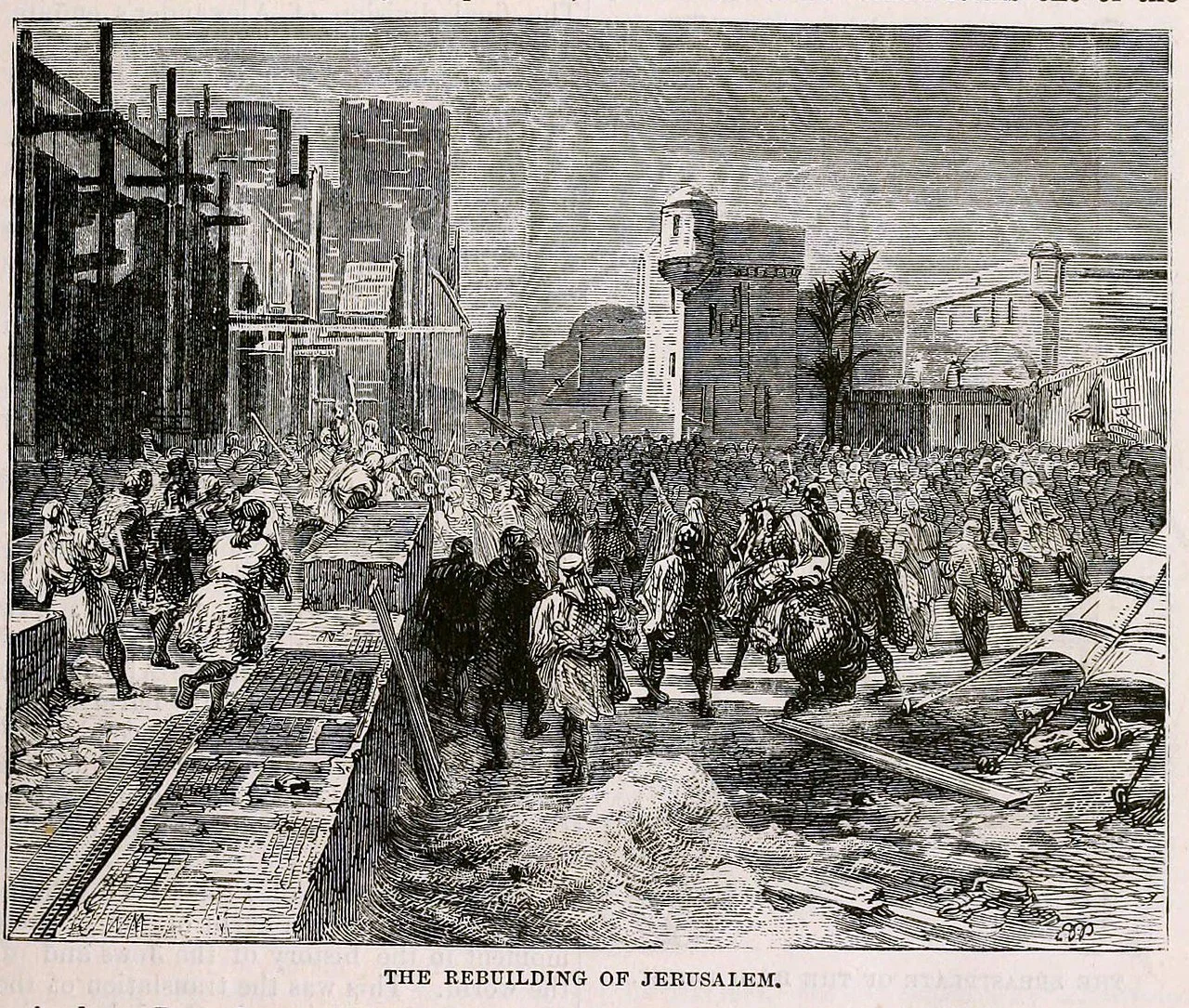
Nehemiah was a Jewish official serving as cupbearer to Artaxerxes, a position of considerable trust, since the cupbearer tasted the king's wine to guard against poisoning. When Nehemiah learned that the walls of Jerusalem remained broken and its gates burned, he was visibly distressed. The king noticed and asked what troubled him. Nehemiah explained and made a request:
"If it please the king, and if thy servant have found favour in thy sight, that thou wouldest send me unto Judah, unto the city of my fathers' sepulchres, that I may build it."
The king granted his request, provided him with letters of safe passage and materials, and Nehemiah returned to Jerusalem to rebuild its walls.
The Long Decline
After Artaxerxes I, the empire entered a long, slow decline. The primary ancient source for this period is Ctesias, a Greek physician who served at the Persian court, though ancient critics already questioned his reliability. Of the eight kings who followed Artaxerxes I over the next century, the majority came to power through assassination or palace coup. The pattern was consistent: a weak king surrounded by powerful court officials, harem intrigues, and rival claimants, producing the same volatile conditions that had killed Xerxes.
The empire held together largely through institutional inertia. The satrapy system Darius had built was robust enough to function without strong central leadership. But revolts became more frequent, Egypt broke away repeatedly, and the Persian military increasingly relied on Greek mercenaries to fight its battles.
Artaxerxes III
Artaxerxes III came to power in 358 BC and ruled with a ruthlessness that temporarily stabilized the empire. He reconquered Egypt, which had broken free decades earlier, and reasserted Persian authority across the empire. To secure his throne, he had all his brothers killed upon taking power, thus eliminating the rival claimants that had destabilized his predecessors.
In 338 BC, he was poisoned, most likely by his chief minister Bagoas, a powerful eunuch who then installed and later poisoned two more kings before the last Achaemenid king, Darius III, had him executed. The empire was fatally weakened when Alexander arrived.
Alexander the Great
The most detailed ancient account of Alexander's conquest comes from Arrian, writing in the 2nd century AD but drawing on eyewitness sources. Alexander the Great began his conquest of Persia in 334 BC.
First, at the river Granicus, modern-day Biga River in Turkey, he defeated a Persian force defending Asia Minor. At Issus, in southern Turkey, in 333 BC, he routed a much larger Persian army commanded by Darius III himself. Darius fled the battlefield, and Alexander captured Darius’s family. Darius attempted to negotiate with Alexander, offering him a daughter in marriage, money, and co-rulership of the empire. Macedonian General Parmenion said, “If I were Alexander, I should accept what was offered and make a treaty.” Alexander replied, “So should I, if I were Parmenion.”

The Alexander Mosaic, depicting the Battle of Issus. Alexander, on horseback at left, routs the Persian army as Darius III flees on his chariot at right. The mosaic is now in the National Archaeological Museum in Naples.
Alexander continued the campaign, defeating Darius III at Gaugamela, in modern-day northern Iraq. One of his own nobles murdered Darius when he tried to flee, marking the end of the Achaemenid empire.
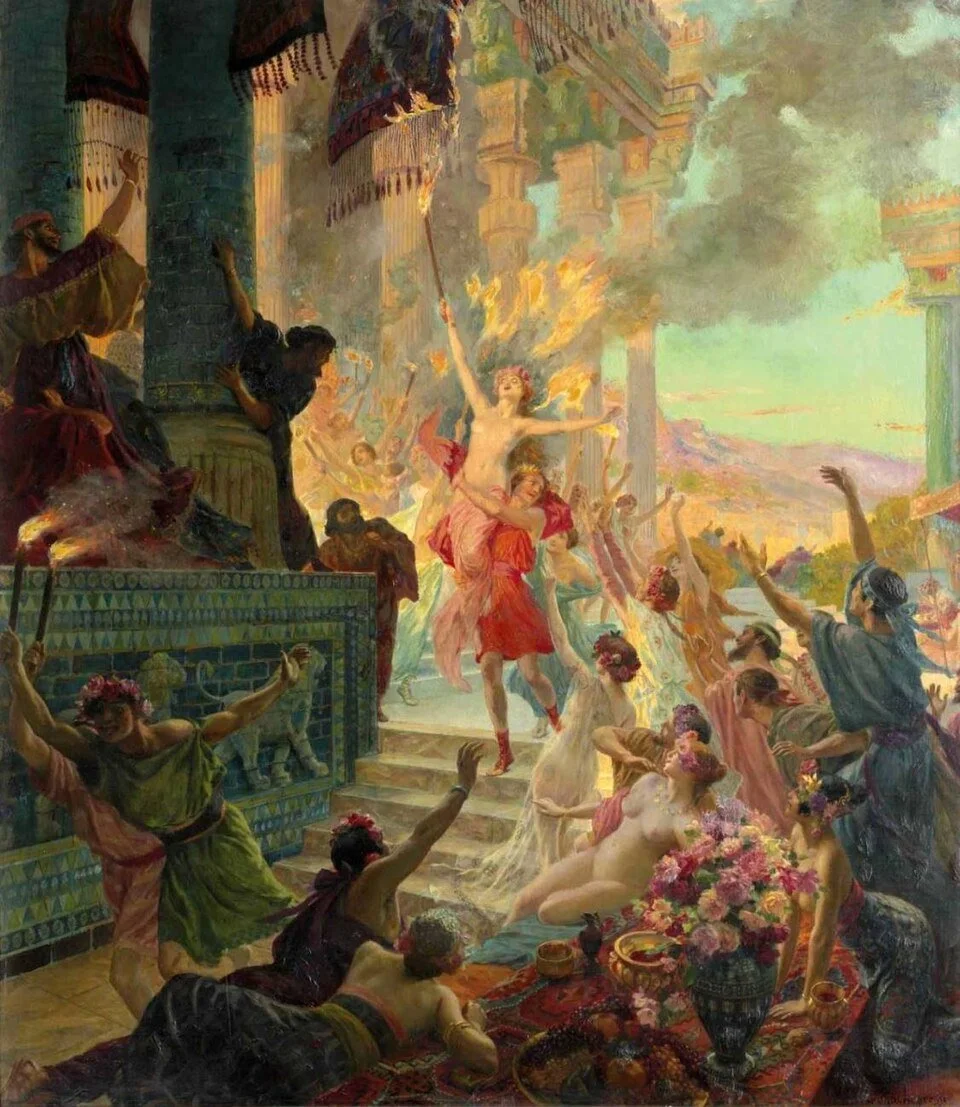
The Burning of Persepolis, painted in 1890 by French artist Georges-Antoine Rochegrosse.
Alexander then took Persepolis and allowed his troops to loot the treasury. According to Greek historian Plutarch, Alexander carried away its treasures on 20,000 mules and 5,000 camels. Then Persepolis was burned. Arrian, Plutarch, and Diodorus Siculus all describe the burning but disagree on whether it was a deliberate act of revenge for the Persian burning of Athens in 480 BC, or a drunken accident at a celebratory feast. Either way, the greatest monument of the Achaemenid empire was reduced to the ruins that stand today.
Alexander and Persia
After the conquest, Alexander did not dismantle the Persian empire. He kept the satrapy system intact, adopted Persian dress and court customs, and presented himself not as a destroyer of Persia but as its legitimate successor.
The Achaemenid Empire, founded by Cyrus the Great in 550 BC, lasted 220 years. At its height, it stretched over 2,000 miles from east to west, encompassing modern-day Iran, Iraq, Turkey, Syria, Lebanon, Israel, Egypt, Afghanistan, Pakistan, and parts of Central Asia and the Caucasus. It was the largest empire the world had yet seen, governing, by some estimates, 44% of the world's population.
The empire's satrapy system allowed dozens of peoples to maintain their own languages, laws, and religions under a single imperial framework. Cyrus allowed Babylonian religious practices and language to continue. The Greeks of Asia Minor were permitted to maintain their city-state structures, laws, and religious practices, and the community survived for another 2,400 years until their expulsion from Turkey in 1922. Cyrus freed the Jewish exiles from Babylon. Darius rebuilt the Temple in Jerusalem. Artaxerxes sent Nehemiah home to rebuild its walls. This sustained tolerance toward conquered peoples was without precedent in the ancient world.
Within decades of Alexander's death, his empire fragmented, and Persia rose again, first under the Parthian empire, then under the Sassanids, who built a civilization that rivaled Rome and whose stories will be told in future installments of this series.