History of Iran - Part 22
The current situation in the Middle East has focused attention on Iran — a country whose history rivals that of any on earth, stretching back over 5,000 years and encompassing 29 UNESCO World Heritage sites. UNESCO (United Nations Educational, Scientific and Cultural Organization) defines a World Heritage Site as a landmark or area recognized for its outstanding cultural, historical, or natural significance and protected under an international treaty for the benefit of all humanity.
This is part 22 of a multi-part series examining that history.
Click here for a list of the articles in this series.
Conquerors of the World
When we think of the greatest conquerors in history, we think of Genghis Khan, Alexander the Great, and Attila the Hun. Julius Caesar and Napoleon also come to mind. Cyrus the Great, ruler of Persia in the 6th century BCE, also amassed one of the world’s largest empires. But what about Timur (Tamerlane)? He is not widely known or remembered. Hollywood has yet to make a blockbuster about his life. And yet, Timur was one of history's greatest military leaders.
And Iran was one of his major conquests.
Timur the Lame
Timur was born in 1336 in Transoxiana, a region in Central Asia encompassing parts of modern-day Uzbekistan and parts of Tajikistan, Kazakhstan, Turkmenistan, and Kyrgyzstan. He was of Mongolian descent, and some genealogies claimed he had a common ancestor with Genghis Khan. His name is Turkic for “iron.” A war wound left him with a limp and a withered hand, and he became known as Timur the Lame. This eventually was westernized into Tamerlane.
His brutality rivaled Genghis Khan’s. He would massacre populations and build towers from the skulls of his victims.
When Transoxiana’s leader, Qazaghan, was murdered in 1358, Timur was already a military leader. He helped Qazaghan’s grandson, Amir Husayn, win back control of his grandfather’s lands. Timur then turned on Husayn, and by 1370 ruled Transoxiana.
Timur ruled an empire but never took the title of khan. Under Mongol tradition, supreme rule belonged to descendants of Genghis Khan, and Timur was not one. To reinforce his legitimacy as ruler, he married Husayn’s widow, who was descended from Genghis Khan.
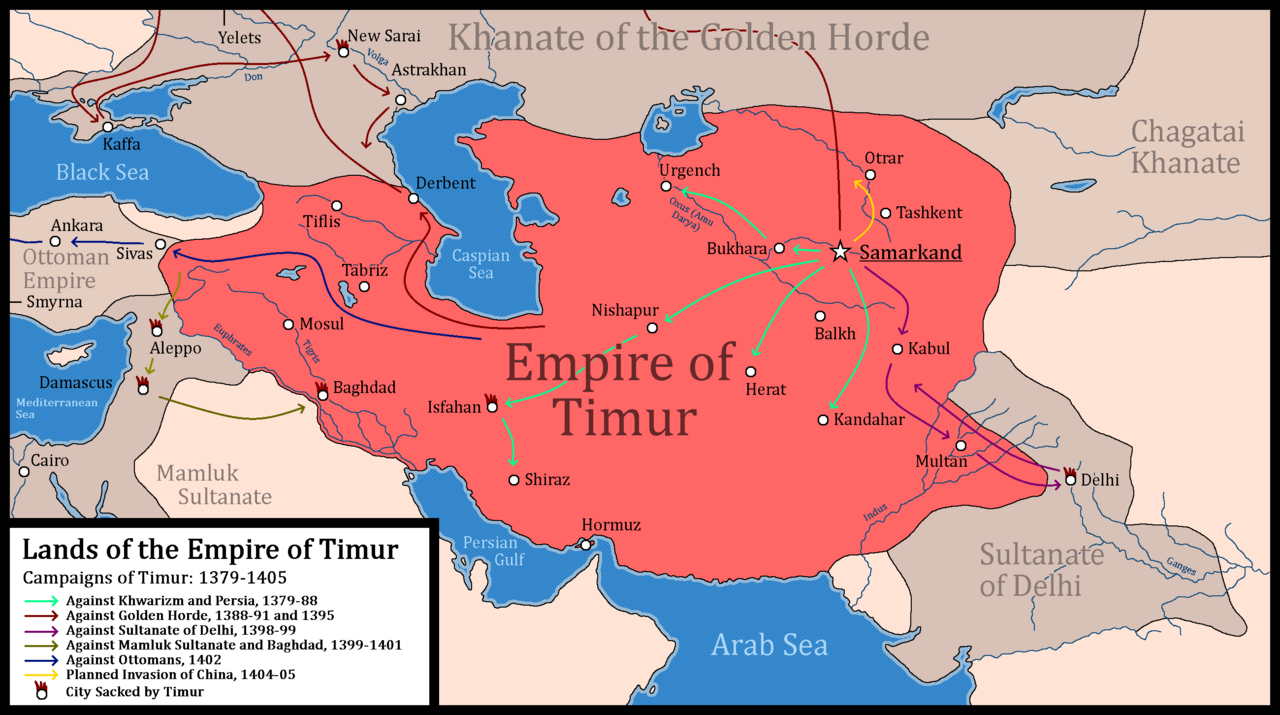
Timurid Empire (click to expand)
HetmanTheResearcher, CC BY 4.0, via Wikimedia Commons
Timur’s Conquests
More than a decade passed between Timur’s victory over Husayn and his move into Iran.
His first target was Herat, in modern-day Afghanistan. It fell in 1381, and Timur extracted tribute and took scholars and artisans back to his lands (in modern-day Uzbekistan).
Isfahan revolted after Timur’s conquest. He ordered a massacre of the residents and was reported to have created over 28 towers of skulls, each containing about 1,500 victims. He had the residents of Baghdad massacred after its conquest. Timur invaded India and sacked Delhi in 1398, killing, by some estimates, over 100,000 people.
He also took Damascus in 1401, and defeated and captured the Ottoman sultan near Ankara in 1402.
Soviet Reconstruction of Timur
By user:shakko - Own work, CC BY-SA 3.0
War Against the Golden Horde
The Golden Horde, a Mongol Khanate ruled by Genghis Khan’s descendants, controlled much of Russia. Timur clashed with them and destroyed their power in a series of battles in 1391 and 1395. The Horde never recovered its former military strength or wealth, which eventually allowed Russia to become independent from Mongol rule. According to legend, Timur stopped short of Moscow due to a miracle performed by the Virgin of Vladimir.
Over five hundred years later, Timur affected Soviet history, according to legend. In 1941, the Soviets opened Timur’s tomb. They gave several reasons, including confirming Timur’s burial site, examining his physical characteristics, and contributing to broader Soviet historical research. The legend is known as the ‘Curse of Timur.’ The local population warned the archaeologists of the curse, which, according to the legend, was: “Whoever opens my tomb will unleash an invader more terrible than I.”
The tomb was opened on June 20. Timur’s remains were removed for study. Two days later, June 22, 1941, Hitler launched Operation Barbarossa, the invasion of the Soviet Union. The resulting war cost the Soviets over 26 million dead. The curse? Coincidence?
Timur’s Mausoleum
Willard84, CC BY-SA 4.0, via Wikimedia Commons
In November 1942, Timur was reburied with full Islamic rites. Legend has it that Stalin gave the order; maybe he thought this would negate the curse. A few days later, the Red Army launched its successful counterattack at Stalingrad, a turning point in the war.
Timur’s Death
The Mongols had established the Yuan dynasty in China in 1271. It fell in 1368 with the establishment of the Chinese Ming dynasty. Timur wanted to reconquer it. He launched the campaign mid-winter and fell ill. He died in February 1405, and the campaign against China was abandoned.
The Timurid Renaissance
After Timur’s death, his sons and grandsons fought each other to control the throne. Eventually, his son, Shah Rukh, won out in 1409. He moved the capital to Herat (modern-day Afghanistan), where he had served as governor prior to Timur’s death.
The Shah shifted the empire from military conquest to science and the arts, a period known as the Timurid Renaissance. His son, Ulugh Beg, who ruled Samarkand, built a massive observatory and produced the Zij-i Sultani, the most important astronomical catalog since Ptolemy. Another son, Baysunghur, became the leading patron of the arts. The Metropolitan Museum says the school of painting that developed was a high point of Persian painting.
Much of what we know about Timur’s life comes from two biographies. While he was still alive, Timur asked historian Nizam al-Din Shami to write his biography. It was called Zafarnama (Book of Victory). After Timur’s death in 1405, Shah Rukh asked another historian, Hafiz-i Abru, to write an extension covering the remainder of Timur’s life. We previously mentioned Rashid al-Din’s Jami’ al-tawarikh, a history of the world. Hafiz also wrote another history, known as the Majma’ al-tawarikh, adding about another hundred years to Rashid al-Din’s work.
Years later, Timur’s grandson Ibrahim Sultan asked another historian, Sharaf ad-Din Ali Yazdi, to write another Zafarnama, using more poetic language.
National Hero of Uzbekistan
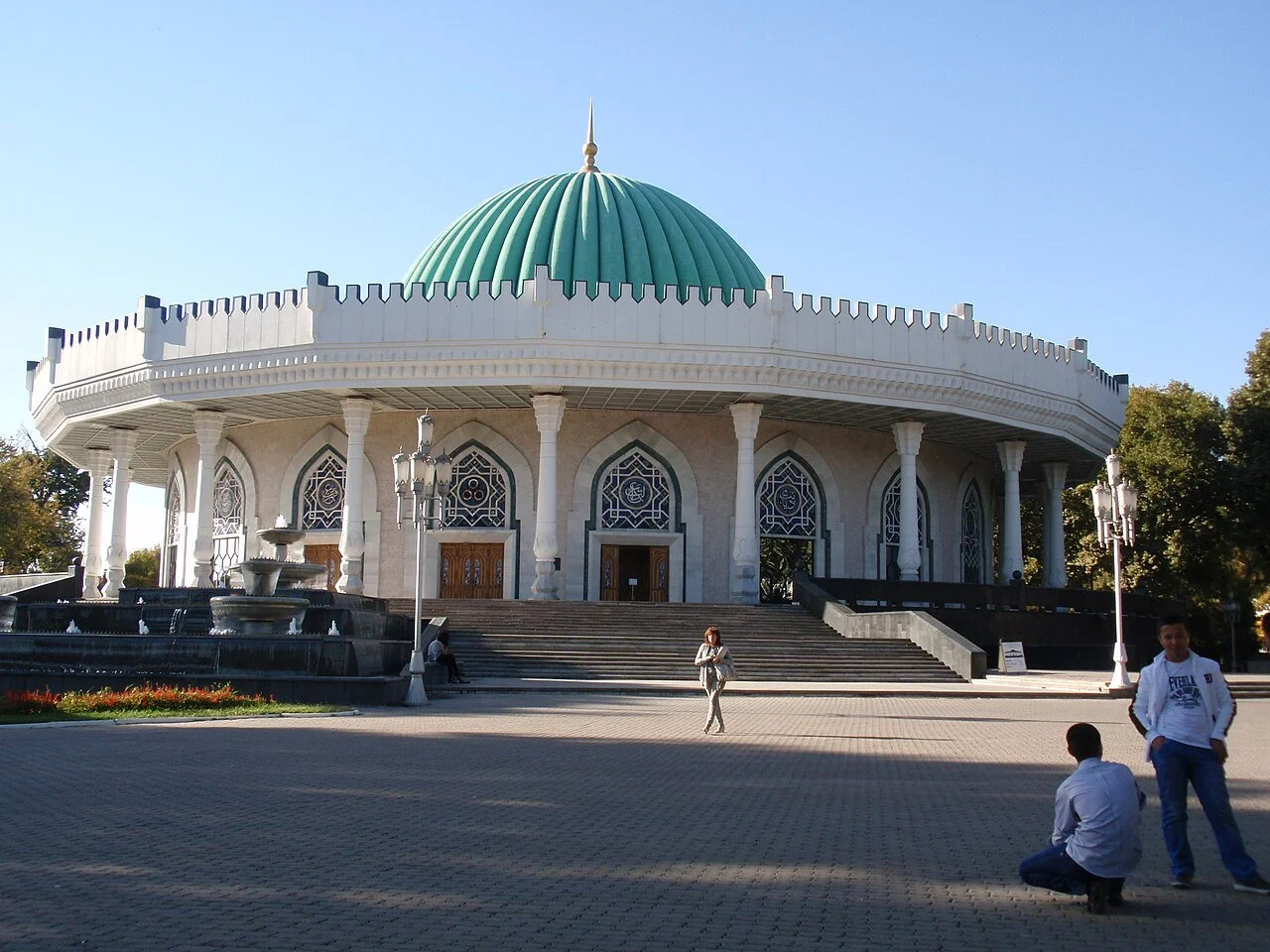
Amir Timur Museum (click to expand)
Doris Ingeborg Lohse, CC BY-SA 4.0, via Wikimedia Commons
Uzbekistan honors Timur, known locally as Amir Timur, as its founding hero. Uzbekistan became independent following the collapse of the Soviet Union in 1991. The government replaced Soviet monuments with statues and museums of Timur. They emphasized his support of the arts and science, not his ruthlessness. In the capital city, Tashkent, the government replaced a statue of Karl Marx with one of Timur. The state opened a museum to mark the 660th anniversary of Timur’s birth, housing weapons, paintings, and other artifacts. The country has also restored Timur’s mausoleum. His statue appears on banknotes, and streets and parks are named after him.
End of the Timurid Empire
After Shah Rukh died in 1447, the realm fragmented. After years of strife and war, the Safavids eventually became Iran's next conquerors, a subject for a future essay.