To the Victor Goes the Spoils - Part 2
The recent Netflix series, ‘Death by Lightning,’ covered the life and death of President Garfield and his assassin, Charles Guiteau. A major issue at the time was governmental corruption through the patronage (spoils) system. Guiteau himself was a disappointed job seeker - he wanted a job in the Garfield administration.
Part 1 of this multi-part series covered the history of the spoils system, starting with its origins under President Andrew Jackson and continuing through Lincoln’s strategic use of patronage to further his goal of preserving the Union. Part 2 describes the scandals and problems of Presidents Johnson and Grant, which resulted in public pressure for reform.
President Andrew Johnson (1865 – 1869)
President Johnson favored a lenient reconstruction period for the South. All they had to do was ratify the 13th Amendment, take a loyalty oath, and abolish slavery. He opposed any requirements to protect Black civil rights. He pardoned virtually all Confederate officers.
However, virtually all federal officeholders (postmasters, customs collectors, internal revenue assessors, U.S. marshals, etc.) had been appointed by Lincoln or earlier Republican administrations. Most of these men were Republicans who strongly supported Reconstruction measures that Johnson opposed, such as awarding the newly freed enslaved people the right to vote.
Using his ability to fire and hire federal employees, he replaced many of them with men who supported his lenient reconstruction policy. He also replaced Republicans with Democrats, his former political party.
The Republicans won an overwhelming Congressional majority in the 1866 mid-term elections. Before the new Congress met in March 1867, Johnson carried out one of the largest number of firings in American history. Johnson wanted to remove as many employees as he could, focusing on those who opposed his reconstruction policy. Since many of these firings occurred on December 13, 1866, his actions became known as the St. Lucia Day Massacres.
The purge backfired, ultimately leading to Johnson’s impeachment. Hans Trefousse, Johnson’s biographer, called it a ‘colossal blunder.’ Pulitzer prize-winning historian Eric Foner said, ‘The great purge of 1866–67… convinced even moderates that Johnson could not be trusted…’
Congress responded by passing the ‘Tenure of Office Act’ in March 1867, requiring Senate approval to dismiss any official whose appointment had been confirmed by the Senate. Believing the act to be unconstitutional, Johnson purposely violated its provisions by dismissing Secretary of War Edwin Stanton. This led to his impeachment. He survived in office by a single vote.
President Ulysses S. Grant - 1869 - 1876
President Grant came into office wanting to reform the Civil Service. In his 1869 inaugural address, he said, ‘…the civil service is a matter in which the whole country is interested. I would have it reformed. The office should go to the man who is best fitted for it, and not be used as a reward for mere party services. ”
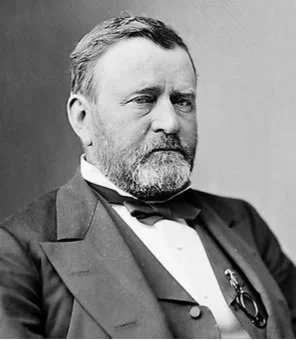
President Grant
He asked for Congressional legislation: ‘It is my firm conviction that the civil service of the Government has become a mere instrument of partisan favoritism… I recommend, therefore, such legislation as will secure the examination of all applicants for the higher grades of the public service…’
He created the first Civil Service Commission, which recommended competitive exams for office. But Congress refused to fund the system, and the Commission was disbanded. Each year, Grant renewed his call for reform, but Congress failed to act, in part because it relied on patronage to reward supporters and party members.
Despite his desire to reform governance, President Grant’s presidency became known for the number of scandals that erupted during his two terms. There is no evidence, however, that Grant profited or was involved in any of these. But his loyalty to friends and appointees allowed them to occur. The list of scandals is long. Some of the highlights (lowlights?):
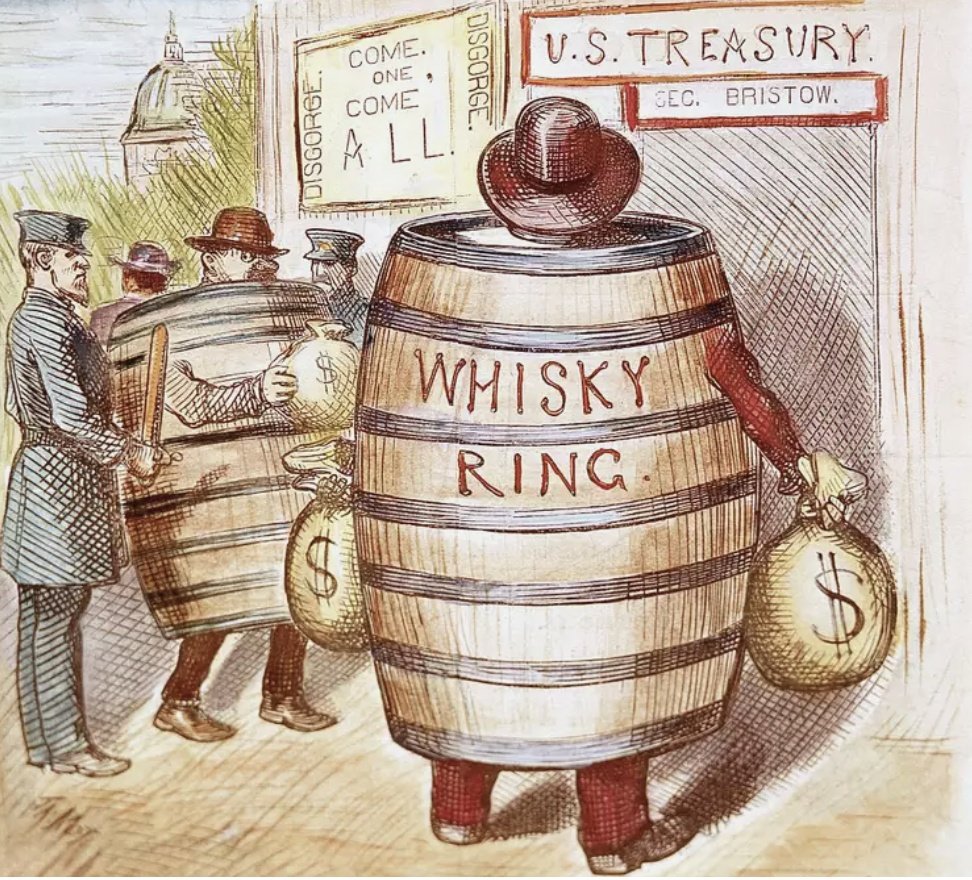
Political Cartoon
Crédit Mobilier – Union Pacific bribed Congressmen and the sitting Vice President to look the other way while they stole millions from a $150 million dollar project. A newspaper expose forced Congress to investigate.
Whiskey Ring – Distillers were bribing treasury officials, including Orville Babcock, Grant’s private secretary, to avoid alcohol excise taxes, costing the government an estimated $1.5 million annually. Grant testified in court in support of his secretary.
Trader Post Ring - Grant’s Secretary of War, William W. Belknap, took kickbacks by selling Indian trading-post appointments. He was impeached by the House of Representatives, but avoided conviction in the Senate by resigning.
Safe burglary conspiracy – Grant’s close friend, Alexander Robey Shepherd, and cronies looted the nation’s capital through rigged contracts. Grant publicly praised Shepherd and kept reappointing him even after the fraud was exposed. Grant biographer Ron Chernow called it ‘…the most indefensible act of his presidency.’
Ironically, the large number of scandals led to public demand for Civil Service reform. The 1876 Republican Party platform explicitly called for reform. As Chernow stated in his biography, ‘Paradoxically, Grant’s greatest indirect contribution to good government was to preside over so much bad government that the public finally demanded change.’
Unfortunately, it took another seven years and a Presidential assassination to achieve reform, as we’ll learn in Part 3 of this series.