To the Victor Goes the Spoils - Part 1
The recent Netflix series, ‘Death by Lightning,’ covered the life and death of President Garfield and his assassin, Charles Guiteau. A major issue at the time was governmental corruption through the patronage (spoils) system. Guiteau himself was a disappointed job seeker - he wanted a job in the Garfield administration.
This multi-part series covers the history of patronage and Civil Service reform in the Federal Government.
President Jackson (1828 – 1836)
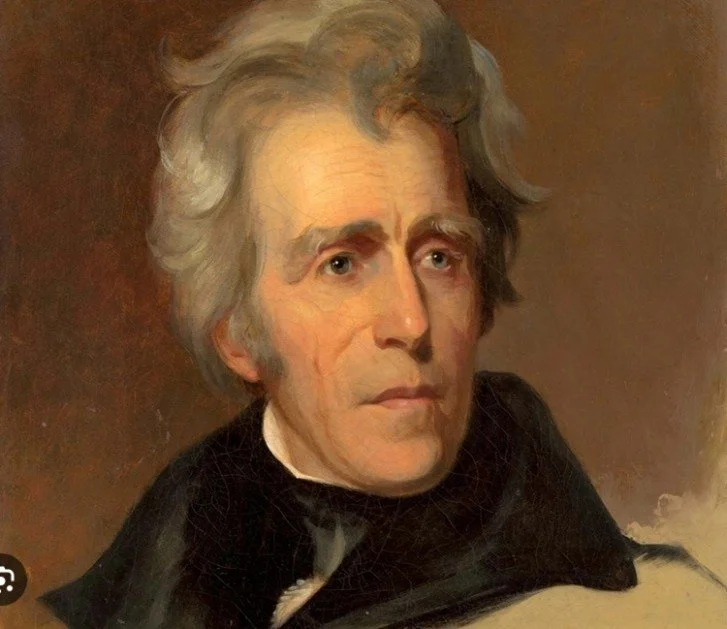
Andrew Jackson
Who should work for the Federal government? Don’t we want competent civil servants who can run the government efficiently and effectively?
When Andrew Jackson won the Presidency n 1828, he believed that entrenched government officials were corrupt, arrogant, and opposed to his electoral platform. He felt that replacing those officials would improve the government's responsiveness to the people.
As he said early in his tenure: “There are, perhaps, few men who can for any great length of time enjoy office and power without being more or less under the influence of feelings unfavorable to the faithful discharge of their public duties... they are apt to acquire a habit of looking with indifference upon the public interests.”
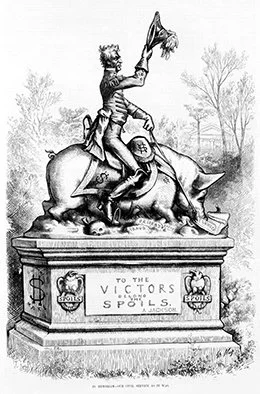
Political Carton About Spoils System, Pig Feeding at Trough
He started a process which he called ‘rotation in office.’ Jackson argued that rotation in office would improve government operations and serve a democratizing function that would curb the importance of privilege in government. He wanted to allow ordinary citizens to participate in government rather than have it run by a permanent bureaucracy.
President Jackson replaced over 10% of the government, more than the prior seven Presidents before him combined. His legal authority was based on the 1820 Tenure of Office Act, which created four-year term limits for government officials and allowed a new president to remove officials for any reason.
This all sounds reasonable on the surface.
But in practice, it became a spoils (patronage) system, in which government jobs were given to supporters, friends, and relatives as a reward for serving the winning political party. And it gave those employees an incentive to continue working for the party. While some were qualified for those positions, others only qualifications were backing the winner.
For example, Samuel Swartwout, a supporter of Jackson, was appointed as Collector of the Port of New York, an important position because it was the single largest source of government revenue from tariff collections. He was later found to have embezzled over $1 million, a staggering sum in those days. The U.S. Customs agency described it as “…carrying out the largest individual theft in the history of…Customs service.”
Pulitzer Prize-winning historian Daniel Walker, in his book, ‘What Hath God Wrought: The Transformation of America, 1815-1848,’ documented several patronage abuses during Jackson’s tenure, including officers in the Post Office, Indian affairs, and land grants.
Jackson’s critics saw his actions as political revenge and leading to corruption. During a debate, Senator William L. Marcy of New York defended the actions of the Jackson administration, stating, "to the victor belong the spoils."
Pre Civil War Period (1837 – 1860)
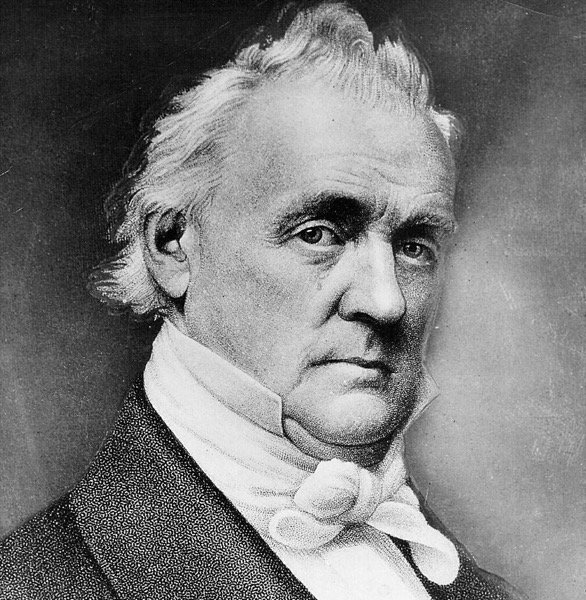
President Buchanan
The spoils system continued to grow during this period. One example was President Buchanan, who was President from 1857 to 1861. Kansas was allowed to use a popular vote referendum to decide whether it would be a free state or a slave state. Buchanan made extensive use of patronage to support the pro-slavery position. He replaced his opponents throughout the government with officials who support his position.
Congress created the Covode Committee, named for its chairman, Representative John Covode, to research Buchanan’s use of patronage. The Committee was given a charter: ‘to investigate whether the President of the United States, or any other officer of the government, has, by money, patronage, or other improper means, sought to influence the action of Congress…’
The committee found that Buchanan had threatened Federal workers with the loss of their posts if they did not support his pro-slavery position. By the time of Lincoln’s election in 1860, the line between patronage and outright corruption was thin. However, Lincoln found he could use these same tools for the good of the nation.
President Lincoln (1860 – 1865)
Lincoln was elected President in a severely divided country, lurching towards civil war.
He was also the leader of the nascent Republican Party, only four years old when he was elected.
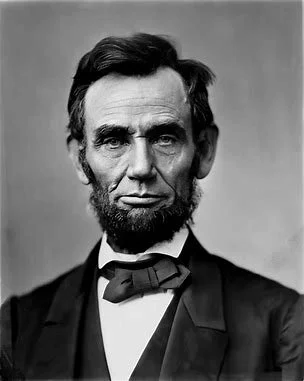
Lincoln
Lincoln tried to preserve the Union by distributing appointments across different regions of the country and to those holding diverse viewpoints. He also needed to eliminate Southern secessionists from the Federal government. He appointed rivals to the government, not only for their political skills but to build a coalition of support. The book ‘Team of Rivals: The Political Genius of Abraham Lincoln,’ by Doris Kearns Goodwin, describes this process in detail.
Lincoln biographer Allen Carl Guelzo wrote that, “no one since Andrew Jackson played with the federal patronage system more vigorously than Lincoln. Of the 1,520 federal offices directly under presidential control, Lincoln emptied nearly 1,200 of them after his election and replaced them with Republicans.” At the time, the Democratic Party supported slavery and, in the South, secession.
Another Lincoln historian, James G. Randall, wrote that President-elect Lincoln “could not ignore entirely the well-established patronage rule of punishing enemies and rewarding friends.
In their book, "Lincoln and the Patronage," historians Harry. J. Carman and Reinhard H. Luthin defended Lincoln’s use of patronage because the Union was falling apart: “Had Lincoln led a united party, he might have utilized his time and effort somewhat differently. His wise use of patronage in holding the party together was a necessary antecedent to the formulation of any statesmanlike policy concerning the nation.
Interestingly enough, earlier in his life, Lincoln petitioned President Zachary Taylor for a patronage appointment. Having worked hard to put Zachary Taylor in office, Lincoln naturally expected to have a say in the distribution of government jobs, which, under the spoils system, went to friends and loyal party members.
At first glance, Lincoln’s use of patronage sounds distasteful. But as a clever politician, he used it to hold together diverse, conflicting factions for the preservation of the Union. It helped his administration succeed and strengthened the Republican Party by rewarding the faithful.
He also used it to support political goals. Lincoln’s supporters wanted to expedite Nevada’s entry into statehood so he could obtain their Electoral College votes in the 1864 election. And his supporters also wanted Nevada’s Congressional vote in what was anticipated to be a tight vote on the 13th Amendment, which banned slavery. Lincoln appointed Republican officials in Nevada to support his goals. And, sure enough, Lincoln won Nevada in 1864, and Nevada voted in favor of the 13th amendment in early 1865!
Curious for more details on Lincoln Patronage? Click here.
After the Civil War
The next installment of this series will continue the investigation of patronage after the Civil War, leading up to the presidency of President James Garfield. As we’ll see, the spoils system directly led to Garfield’s assassination.